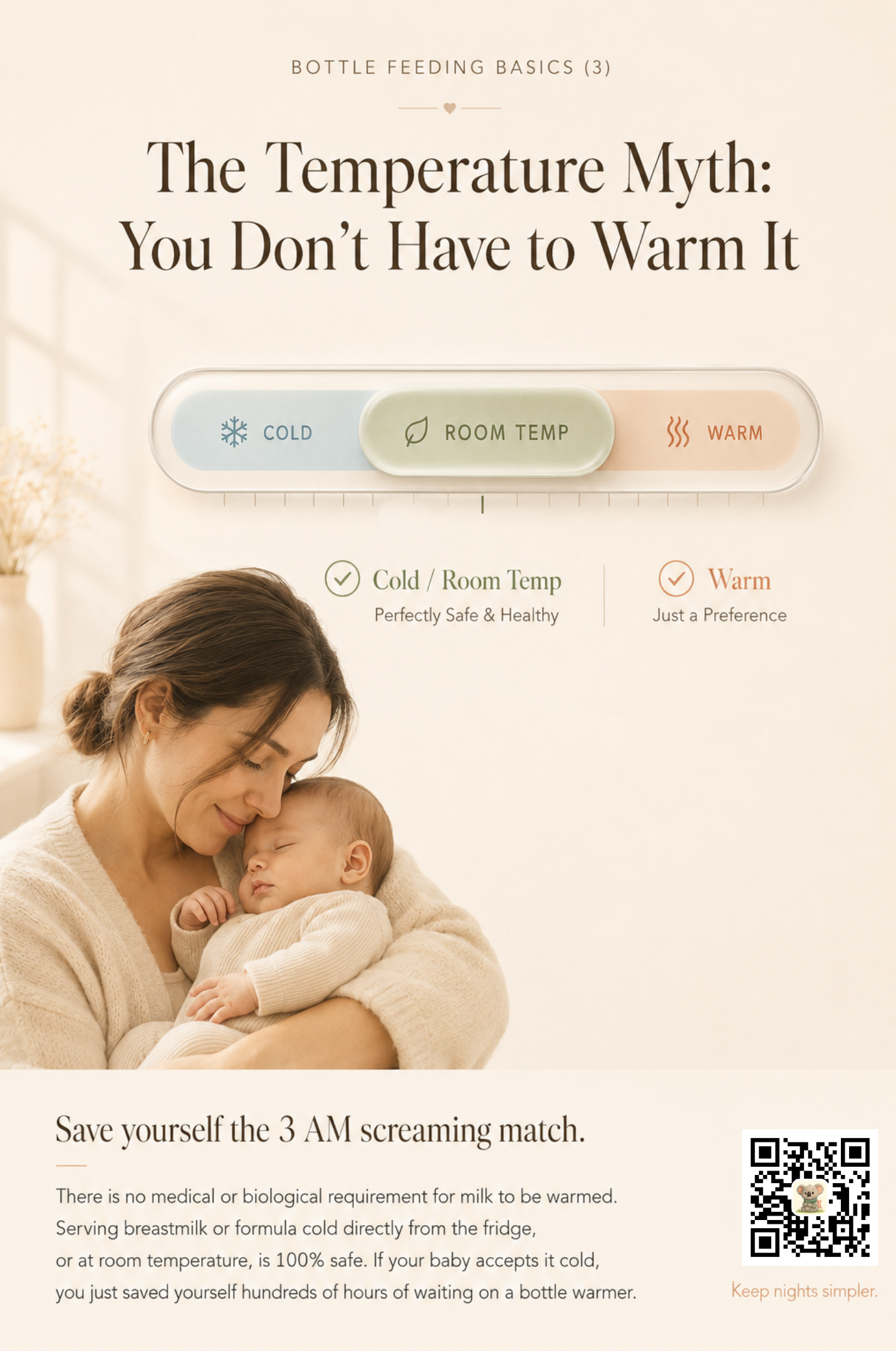
Save yourself the 3 a.m. screaming match.
There is no medical or biological requirement for milk to be warm. Cold or room-temperature breastmilk and formula are 100% safe. If your baby accepts it cold, you just saved yourself hundreds of hours over a bottle warmer.
Where the warming tradition came from
The custom of warming bottles isn’t medical — it’s cultural. Two threads converged:
- Mimicking breastmilk. Milk from the breast is body temperature (~98°F). Mid-century formula marketing leaned into this comparison.
- Glass bottle safety. When bottles were glass and sterilization happened in pots of boiling water, warming was practical — bottles were already hot.
Neither reason still applies. Modern bottles are sterile from the factory or after a single wash. And there’s no biological requirement that infants drink at body temperature.
The science: temperature and nutrition
Temperature doesn’t change the nutritional content or digestibility of breastmilk or formula:
- Cold milk is digested at the same rate as warm milk in healthy term infants.
- Breastmilk immunological properties are preserved whether served cold or warmed.
- No published research links cold milk to colic, gas, or feeding refusal in healthy infants.
What does change with temperature: your baby’s preference. Babies introduced to cold or room-temperature milk from the start usually accept it. Babies trained on warm milk often refuse anything cooler — not because they can’t digest it, but because they’ve learned to expect warm.
What actually matters — handling and storage
The real food-safety rules for breastmilk and formula are about handling and storage, not temperature at serving:
- Breastmilk: Up to 4 hours at room temperature, 4 days refrigerated, 6–12 months frozen (per CDC).
- Prepared formula: Up to 2 hours at room temperature, 24 hours refrigerated. Discard anything left after a feed.
- Warmed milk: Don’t re-warm. Don’t microwave (uneven heating creates hot spots). Use a warmer or run under warm tap water for 1–2 minutes if you choose to warm.
- Test temperature on your wrist before feeding. Warm milk should feel neutral — not hot.
How to introduce cold or room temp
If you’ve been warming and want to stop:
- Take a feed at room temperature first — not cold from the fridge. This is a gentler step.
- Try a less-hungry feed (mid-day, not bedtime) when the baby is more flexible.
- If they accept room temp easily, try fridge-cold the next day.
- If they refuse, return to warm and try again in a few days. Don’t force.
Many babies accept the change within 1–2 days. Some take a week. A few won’t budge — and that’s fine. The point isn’t to win a battle, it’s to give yourself an option for 3 AM and travel.
One last thing
If warming a bottle works for your family, keep doing it. There’s nothing wrong with warm milk. But if you’ve been doing it because you thought you had to, you don’t. The middle-of-the-night version of you will thank you.
Sources & further reading
- Centers for Disease Control and Prevention. Proper Storage and Preparation of Breast Milk.
- Centers for Disease Control and Prevention. Infant Formula Preparation and Storage.
- American Academy of Pediatrics. Feeding Your Baby.
- U.S. Food and Drug Administration. Food Safety for Moms-to-Be: Once Baby Arrives.
Track every feed, diaper, and sleep — in one calm log.
ParentFlow helps you see your baby’s real rhythm without spreadsheets or guesswork.
Download on App StoreThis article was written against current AAP, CDC, WHO, and IBCLC clinical guidance and is for educational purposes only. It does not constitute medical advice. ParentFlow is a wellness companion — not a substitute for your pediatrician or lactation consultant. For medical concerns, always consult a qualified healthcare provider.
All third-party trademarks, organization names, and publication titles are the property of their respective owners and are referenced under fair use for educational purposes.