Respect their “full” cues.
When baby turns their head, splays fingers, or seals their lips, the meal is over. Don’t wiggle the bottle. Don’t force the last ounce. Forcing overrides their fullness sensors — the very signals they’ll rely on for life.
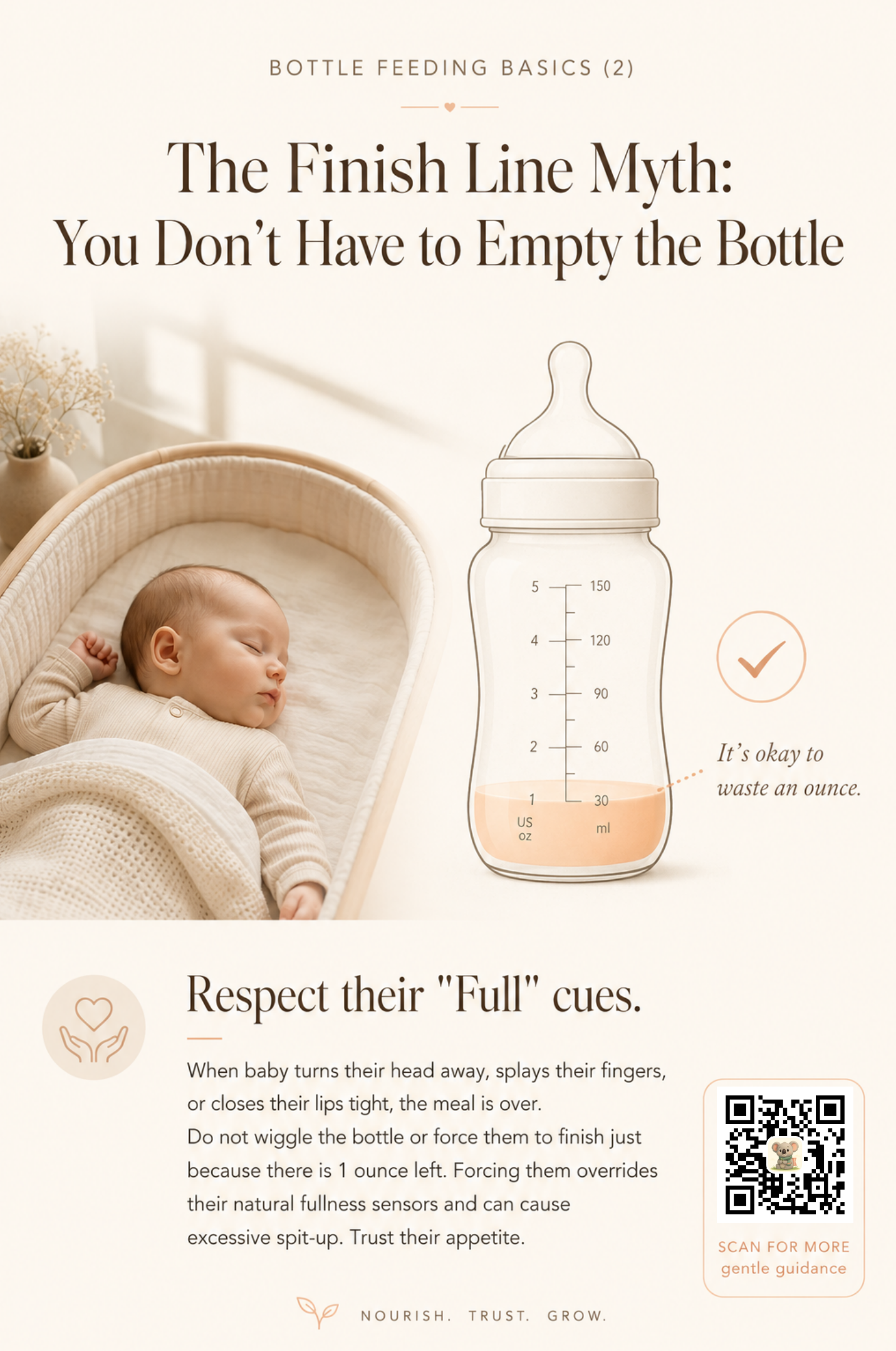
Infant fullness cues
Babies signal fullness clearly. The cues are subtle if you’re not watching, obvious once you know:
- Turning the head away from the bottle.
- Splaying or relaxing the fingers. Hungry babies have tight, balled fists. Full babies have open, soft hands.
- Sealing the lips tight or pushing the nipple out with the tongue.
- Slowing or stopping suckling even with milk available.
- Falling into relaxed, easy breathing.
When you see two or more, the meal is over — regardless of what’s left in the bottle.
Why we want to finish the bottle
The instinct to finish the bottle is adult, not infant. Three forces drive it:
- Waste anxiety. Pumped breastmilk and prepared formula represent real cost — time, money, effort. Tossing 1 oz feels wrong.
- Performance signaling. “She finished her whole bottle” sounds like success. It’s really just a measurement.
- Sleep math. Parents trying to engineer longer sleep stretches push for “one more ounce” before bedtime, hoping it’ll buy time.
None of these are about the baby’s needs. They’re about ours. And when they override the baby’s cues, they cost more than they save.
The long-term cost of overfeeding
Research on responsive feeding consistently shows that infants who are fed past their fullness cues learn to disregard those cues. The downstream effects:
- Higher risk of overweight in toddlerhood and early childhood.
- Reduced ability to self-regulate intake in later life.
- More feeding-related conflict during toddler “picky eater” phases — because the baby was trained to override their own signals.
The 1 oz you saved at six weeks isn’t worth the eating pattern it built.
Reducing waste without forcing
You don’t have to choose between waste and force-feeding. Adjust the pour:
- Start with smaller volumes. Pour 3 oz when you used to pour 4. You can always add another oz.
- Use smaller bottles. A 4-oz bottle feels less wasteful when half-finished than an 8-oz bottle.
- Track average intake over a week, not per feed. Babies vary feed to feed. A whole week tells the truer story.
- Save leftover bottles for 1–2 hours. Breastmilk and formula can typically be refrigerated and re-offered within safety windows; check current AAP and CDC guidelines.
One last thing
Wasting an ounce of milk is a small, immediate cost. Training your baby to ignore their own fullness signals is a large, long-term cost. The math favors the ounce.
Sources & further reading
- DiSantis, K. I., Hodges, E. A., Johnson, S. L., & Fisher, J. O. (2011). The role of responsive feeding in overweight during infancy. International Journal of Obesity, 35(4).
- Hodges, E. A., et al. (2008). Maternal decisions about the initiation and termination of infant feeding. Appetite, 50(2–3).
- American Academy of Pediatrics. Bottle Feeding Basics.
- Black, M. M., & Aboud, F. E. (2011). Responsive feeding is embedded in a theoretical framework of responsive parenting. Journal of Nutrition, 141(3).
Track every feed, diaper, and sleep — in one calm log.
ParentFlow helps you see your baby’s real rhythm without spreadsheets or guesswork.
Download on App StoreThis article was written against current AAP, CDC, WHO, and IBCLC clinical guidance and is for educational purposes only. It does not constitute medical advice. ParentFlow is a wellness companion — not a substitute for your pediatrician or lactation consultant. For medical concerns, always consult a qualified healthcare provider.
All third-party trademarks, organization names, and publication titles are the property of their respective owners and are referenced under fair use for educational purposes.