Slower is better.
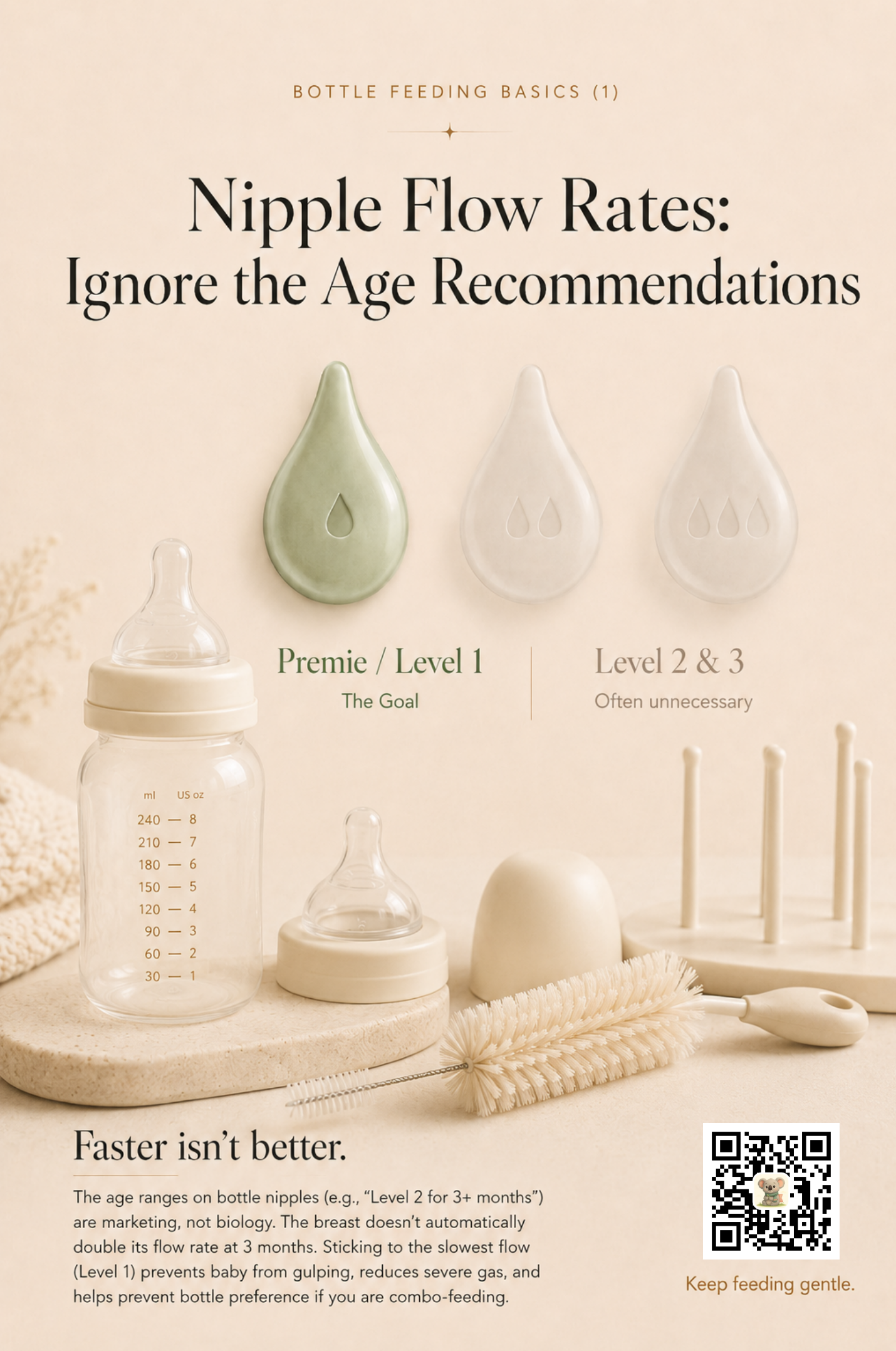
The age ranges printed on bottle nipples are marketing, not biology. Your breast doesn’t automatically double its flow rate at three months. Stay on Level 1 longer than the box says.
Why manufacturers push faster flow
Nipple boxes labeled “3+ months,” “6+ months,” “Stage 2,” and so on suggest a biological progression. Babies need more milk faster as they grow, the marketing implies, so the nipple should keep up.
The premise is wrong. Breast flow rate does not increase with age — if anything, it stabilizes once supply matures. A 6-month-old breastfeeding from a 6-month-old’s breast is drinking at the same flow rate as a 6-week-old. The volume is larger; the rate per swallow isn’t.
The age stages on nipples exist primarily because pediatric feeding research has documented that faster flow makes a feed look more “successful” on the box — a baby chugs and finishes faster — and that sells more nipples. The biology doesn’t support the staging.
What slow flow does
Sticking with the slowest available flow nipple (often called Premie, Level 0, or Level 1) preserves three important behaviors:
- Paced suck-swallow-breathe coordination. Slow flow forces the baby to actively draw milk, the same way they would at the breast.
- Time for fullness cues to register. Stomach-to-brain fullness signals take 15–20 minutes. A baby finishing a bottle in 5 will eat past full.
- Lower swallowed air, less gas. Air bubbles in fast-flow bottles are common; slow flow minimizes them.
When faster flow IS needed
There are real cases for faster nipples:
- Premature infants who tire easily and need fewer suck-cycles per feed (under direct pediatric guidance).
- Babies with cardiac conditions who can’t sustain the work of slow-flow feeding.
- Babies with oral motor issues (cleft palate, certain syndromes) who can’t generate adequate suction.
For typical healthy term infants, none of these apply. Stay on Level 1.
Combo-feeding nipple choice
If you’re combo-feeding (some breast, some bottle), nipple flow is the single most important variable. A bottle that flows easier than your breast will train the baby to prefer the bottle — the “bottle preference” or “nipple confusion” many parents fear.
- Use the slowest-flow nipple you can find.
- Use paced bottle feeding for every bottle.
- If breastfeeds become difficult after introducing bottles, switch to an even slower nipple before assuming the breast is the problem.
One last thing
“Slower is better” is one of the most counterintuitive feeding lessons of the first year. Most parents instinctively want faster, more efficient feeds. The babies who get them often pay for them in gas, spit-up, and the loss of natural fullness signals. Trust slow.
Sources & further reading
- Pados, B. F., Park, J., Thoyre, S. M., Estrem, H., & Nix, W. B. (2015). Milk flow rates from bottle nipples used for feeding infants who are hospitalized. American Journal of Speech-Language Pathology, 24(4).
- International Lactation Consultant Association. ILCA.
- American Academy of Pediatrics. Bottle Feeding Basics.
- Kassing, D. (2002). Bottle-feeding as a tool to reinforce breastfeeding. Journal of Human Lactation, 18(1).
Track every feed, diaper, and sleep — in one calm log.
ParentFlow helps you see your baby’s real rhythm without spreadsheets or guesswork.
Download on App StoreThis article was written against current AAP, CDC, WHO, and IBCLC clinical guidance and is for educational purposes only. It does not constitute medical advice. ParentFlow is a wellness companion — not a substitute for your pediatrician or lactation consultant. For medical concerns, always consult a qualified healthcare provider.
All third-party trademarks, organization names, and publication titles are the property of their respective owners and are referenced under fair use for educational purposes.