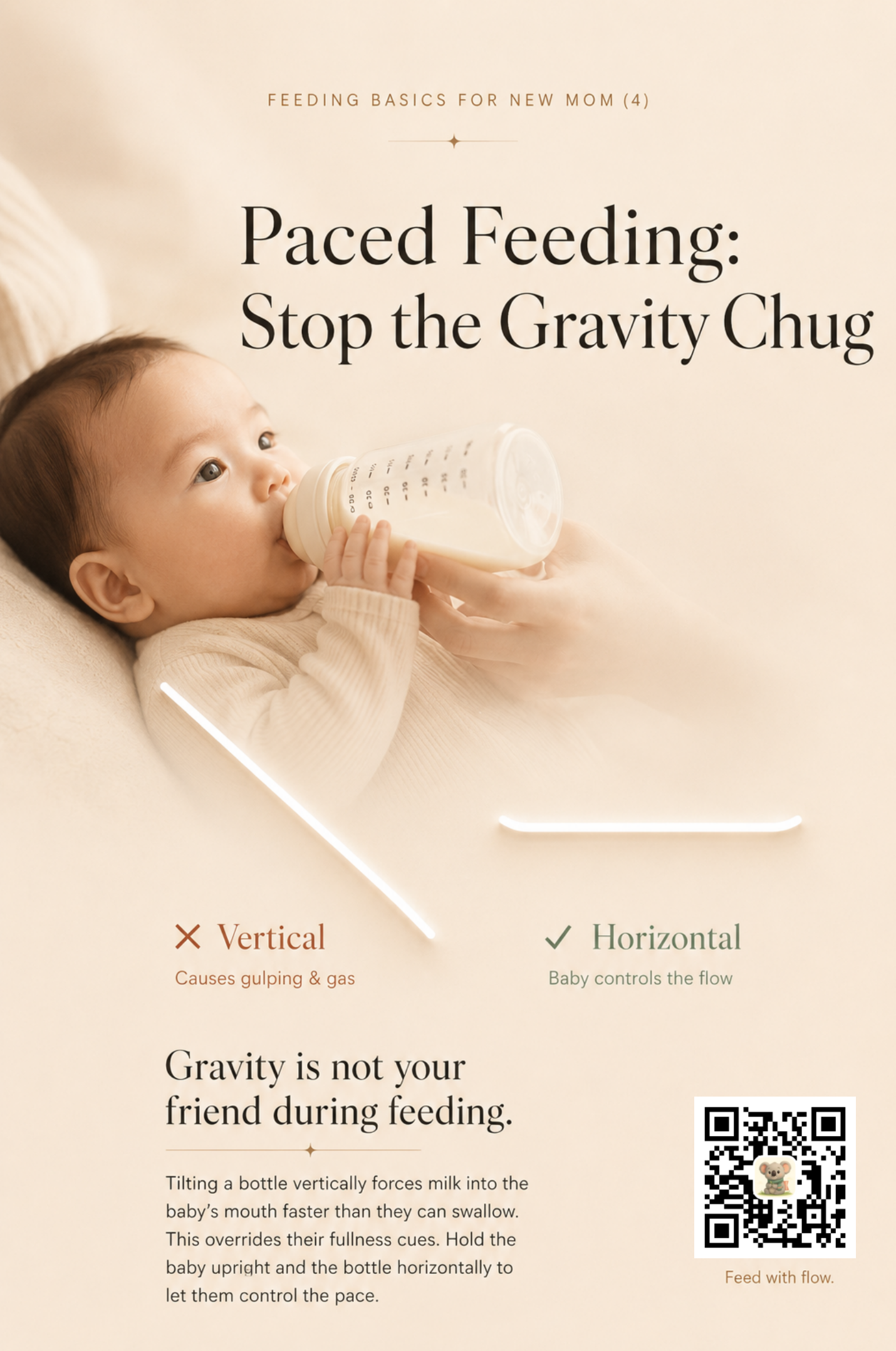
Gravity is not your friend during feeding.
A vertically tipped bottle dumps milk faster than baby can swallow. Hold the baby upright and the bottle horizontal — let them control the flow. This is paced bottle feeding, and it changes everything.
The physiology of paced feeding
At the breast, milk flows in response to a complex coordination of suck, swallow, and let-down. The baby controls the pace. They pause, breathe, signal, and the breast responds.
A bottle tipped vertically removes that coordination. Milk flows by gravity whenever the nipple is in the baby’s mouth, regardless of whether they’re ready to swallow. The result: babies gulp, swallow air, and overshoot their fullness signals.
Paced bottle feeding restores the baby’s control by holding the bottle horizontal — the milk only enters when the baby actively draws it.
Why fast flow causes problems
Bottles that flow too fast (whether from nipple shape or vertical hold) reliably cause:
- Gas and discomfort. Air swallowed alongside fast-flowing milk creates the painful tummy after feeds.
- Spit-up. A stomach overfilled past its capacity sends the excess back up.
- Bottle preference. A breastfed-and-bottle-fed baby who experiences fast bottle flow can develop a preference for the easier delivery, making breast feeds frustrating.
- Overfeeding. Fullness cues take 15–20 minutes to register. A baby finishing 4 oz in 4 minutes will eat past full before their body says stop.
Step-by-step technique
Paced bottle feeding has four core moves:
- Hold the baby upright. Sitting up, not reclined. Their body should be roughly 45–90 degrees from horizontal.
- Hold the bottle horizontal. Just enough tilt that the nipple stays filled. The base of the bottle is parallel to the floor.
- Let them latch when they cue. Touch the nipple to their lips and wait for them to open and accept it. Don’t push it in.
- Pause every 1–2 minutes. Tip the bottle horizontal so no milk flows. Wait 10–15 seconds. If the baby roots back, continue. If they turn away, the feed is done — even if there’s milk left.
The whole feed should take 15–20 minutes. If it’s done in 5, the flow is too fast.
Combo-feeding considerations
If you’re combo-feeding (some breast, some bottle), paced feeding is the single most important practice to preserve breastfeeding. Bottles delivered too easily train the baby to prefer them.
- Use the slowest-flow nipple available (often labeled “preemie” or “Level 1”).
- Have someone else give bottles when possible, so the breast remains the feeding parent.
- If breastfeeds become difficult, slow the bottle further before assuming the breast is the problem.
One last thing
Paced bottle feeding is the smallest change with the biggest payoff. Five minutes of new technique can fix the after-feed fussiness that’s been ruining evenings. Try it for three feeds before judging.
Sources & further reading
- Kassing, D. (2002). Bottle-feeding as a tool to reinforce breastfeeding. Journal of Human Lactation, 18(1).
- International Lactation Consultant Association. ILCA.
- American Academy of Pediatrics. Bottle Feeding Basics.
- Pados, B. F., Park, J., Estrem, H., & Awotwi, A. (2016). Assessment tools for evaluation of oral feeding in infants younger than 6 months. Advances in Neonatal Care, 16(2).
Track every feed, diaper, and sleep — in one calm log.
ParentFlow helps you see your baby’s real rhythm without spreadsheets or guesswork.
Download on App StoreThis article was written against current AAP, CDC, WHO, and IBCLC clinical guidance and is for educational purposes only. It does not constitute medical advice. ParentFlow is a wellness companion — not a substitute for your pediatrician or lactation consultant. For medical concerns, always consult a qualified healthcare provider.
All third-party trademarks, organization names, and publication titles are the property of their respective owners and are referenced under fair use for educational purposes.