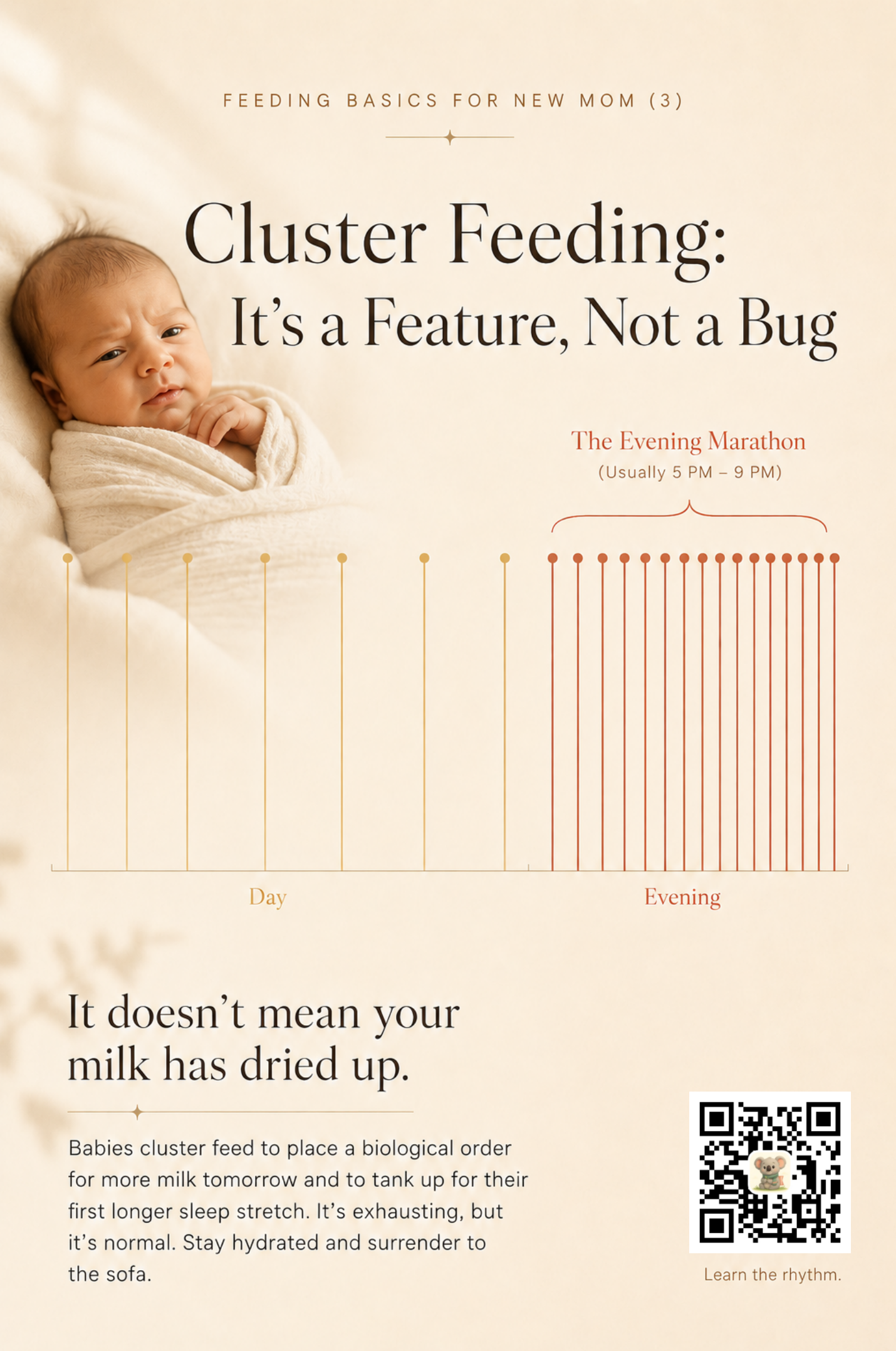
Cluster feeding is a feature, not a bug.
When your baby suddenly wants to feed every thirty minutes in the evening, it isn’t a supply problem. It’s biology placing an order for tomorrow’s milk — and tanking up before the longest sleep stretch.
What cluster feeding actually does
Cluster feeding is the technical name for short, back-to-back feeds packed into a few hours. It looks frantic; it is purposeful. Two things are happening simultaneously inside your baby:
- Prolactin signaling. Every time the breast is emptied, prolactin spikes. Repeated emptying tells your body to make more milk over the next 24–48 hours. Cluster feeding is biology placing an order.
- Tank-up before the long stretch. Cluster feeds also pack in calories before the longest night-time sleep block. A baby cluster-feeding from 5–9 PM is often the same baby who gives you a longer first-night-stretch.
Why it concentrates in the evening
Cluster feeding isn’t random. Multiple forces converge between 4 PM and 10 PM:
- Circadian peak in prolactin. Prolactin secretion rises in the early evening, naturally boosting supply availability.
- Sleep pressure building. Your baby’s body knows the longest sleep stretch is coming.
- Supply low point. Many parents report the breast feels “empty” in the evening — this is normal. Milk fat content actually rises later in the day, so smaller volumes are denser.
The combination is by design. The hungry, fussy, wants-to-be-held evening baby is not a malfunctioning system. They’re a system optimizing.
How to survive a cluster night
Cluster feeding is real work for the feeding parent. Make it sustainable:
- Set up before 4 PM. Water bottle, snacks, phone charger, remote, blanket. You’re going to be in one spot.
- Skip the timer. Don’t track minutes. Offer breast or bottle on cue, switch sides as the baby slows down.
- Outsource the room. If you have a partner, this is their dishes-and-laundry hour. Your only job is feeding.
- Surrender to the sofa. Don’t try to multitask. The evening marathon ends faster when you stop fighting it.
When cluster feeding is NOT cluster feeding
Most evening clusters are normal. But some patterns warrant a closer look:
- 24/7 cluster feeding (not just evening) that doesn’t taper after a week.
- Feeds always interrupted by screaming, arching, or breaking the latch.
- Output dropping (fewer wet diapers, dark urine, lethargy).
- Weight loss or failure to regain birth weight by 2 weeks.
These can indicate true supply issues, oral motor problems, reflux, or food intolerance — all treatable. Call your pediatrician or an IBCLC.
One last thing
Cluster feeding peaks during growth spurts (often 2–3 weeks, 6 weeks, 3 months, 6 months) and tapers within a few days. If tonight feels endless, it’s a stage. The sofa knows.
Sources & further reading
- La Leche League International. Cluster Feeding and Fussy Evenings.
- American Academy of Pediatrics. Breastfeeding.
- Kent, J. C., Mitoulas, L. R., et al. (2006). Volume and frequency of breastfeedings and fat content of breast milk throughout the day. Pediatrics, 117(3).
- Cregan, M. D., & Hartmann, P. E. (1999). Computerized breast measurement from conception to weaning: clinical implications. Journal of Human Lactation, 15(2).
Track every feed, diaper, and sleep — in one calm log.
ParentFlow helps you see your baby’s real rhythm without spreadsheets or guesswork.
Download on App StoreThis article was written against current AAP, CDC, WHO, and IBCLC clinical guidance and is for educational purposes only. It does not constitute medical advice. ParentFlow is a wellness companion — not a substitute for your pediatrician or lactation consultant. For medical concerns, always consult a qualified healthcare provider.
All third-party trademarks, organization names, and publication titles are the property of their respective owners and are referenced under fair use for educational purposes.