Crying is a late hunger alarm.
By the time the cry starts, your baby has been signaling for ten minutes. The earliest cues are quiet — stirring, rooting, hands to mouth. Catch them, and the feed is calmer for both of you.
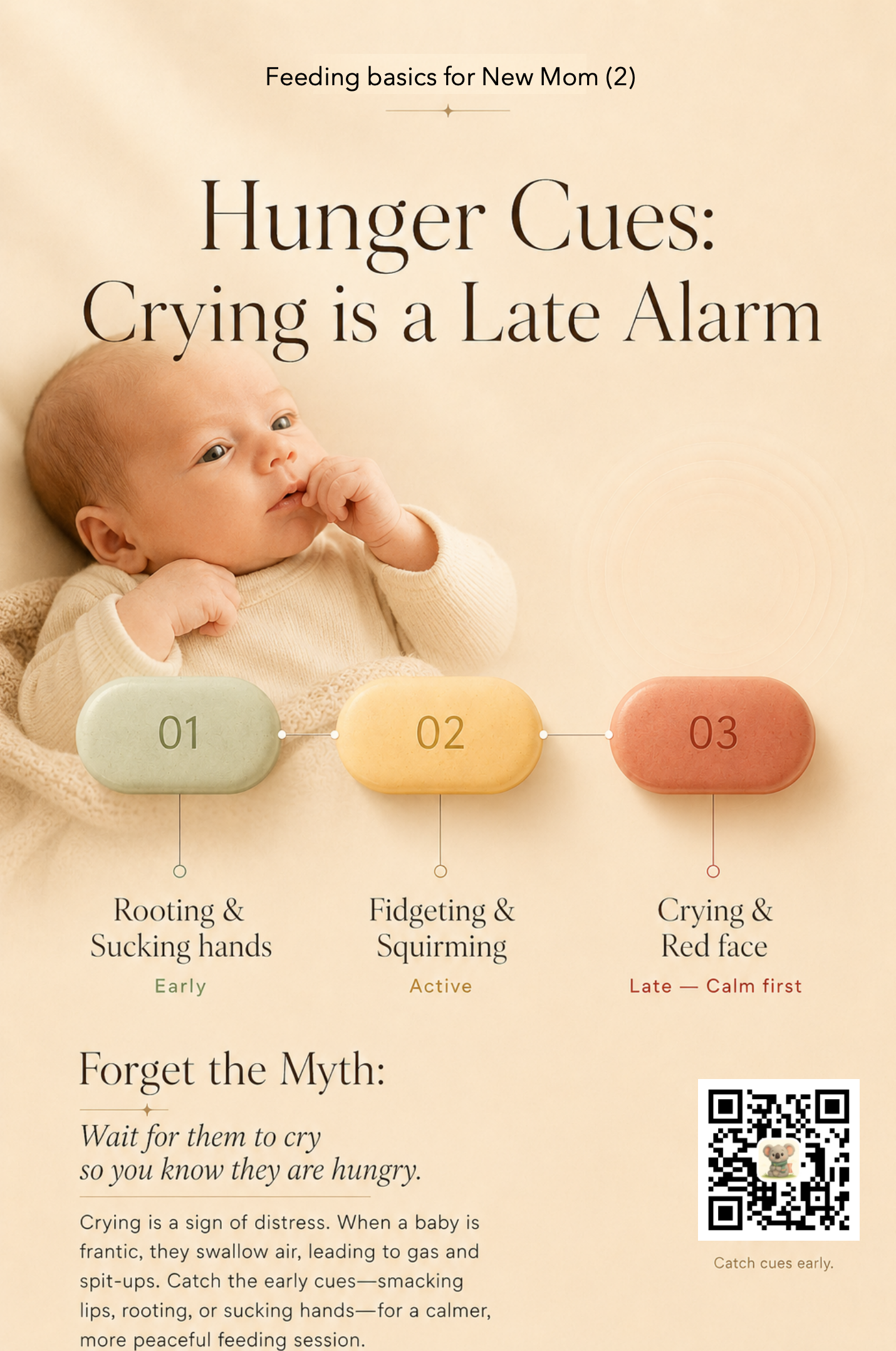
The three stages of hunger
Pediatric feeding research consistently describes three stages of newborn hunger cues. Catching them early is the single highest-leverage skill of the first weeks:
- Early. Stirring during light sleep, opening the mouth, turning the head, sucking on hands or fingers, rooting (turning toward anything that brushes the cheek).
- Active. Stretching, increased physical movement, fussing or short bursts of sound, hands and fists more insistent toward the mouth.
- Late. Crying, red face, jerky movements, agitation. By this stage, the easy feeding window has closed.
A useful rule of thumb: if you can hear it across the room, you’re already late. Effective hunger cues are quiet.
Why crying makes the feed harder
A crying baby is, biologically, a baby in distress. Their body floods with cortisol, their respiratory rate spikes, and they swallow large volumes of air. By the time you try to latch them, they:
- Can’t coordinate the suck-swallow-breathe rhythm.
- Take a shallow latch and dislike it once they realize, prolonging crying.
- Take in air alongside milk, which causes the gas, hiccups, and spit-up that often follow a frantic feed.
Crying isn’t a sign your baby is “really” hungry. It’s a sign the system is now stressed. The fix is to settle the baby first, then feed.
Where the “wait for the cry” advice came from
Two generations of feeding advice told parents to wait for crying so they wouldn’t “spoil” the baby or feed too often. This was the era of strict 4-hour schedules and contributed to widespread early supply problems and unnecessary formula supplementation.
Current AAP and WHO guidance is the opposite: feed on cue, not on the clock. You cannot overfeed a newborn responding to natural cues.
If you missed the early cues
It happens. You step away for a phone call, you misread a sleepy moment, the baby skipped a few cues. By the time they’re crying, the feeding window has tightened — but it isn’t closed.
- Settle first. Skin-to-skin contact, gentle bouncing, white noise. Get the baby out of the cortisol state.
- Offer when calm. A baby in active crying often refuses the breast or bottle. A baby who’s just stopped crying is ready.
- Slow the feed. Take pauses. Burp halfway through. Use paced bottle feeding if you’re bottle-feeding.
One last thing
Cue-reading is pattern recognition that gets faster with reps. Logging when your baby fell asleep easily — or fed easily — for a week reveals your baby’s actual rhythm. Trust the cues you keep seeing, not the chart you saved.
Sources & further reading
- American Academy of Pediatrics. How Often and How Long to Breastfeed.
- World Health Organization. Breastfeeding.
- Brown, A., & Arnott, B. (2014). Breastfeeding duration and early parenting behaviour: the importance of an infant-led, responsive style. PloS One, 9(2).
- McNally, J., et al. (2016). Communicating hunger and satiation in the first 2 years of life: a systematic review. Maternal & Child Nutrition, 12(2).
Track every feed, diaper, and sleep — in one calm log.
ParentFlow helps you see your baby’s real rhythm without spreadsheets or guesswork.
Download on App StoreThis article was written against current AAP, CDC, WHO, and IBCLC clinical guidance and is for educational purposes only. It does not constitute medical advice. ParentFlow is a wellness companion — not a substitute for your pediatrician or lactation consultant. For medical concerns, always consult a qualified healthcare provider.
All third-party trademarks, organization names, and publication titles are the property of their respective owners and are referenced under fair use for educational purposes.