A newborn’s stomach is cherry-sized.
On day one, your baby’s tummy holds 5–7 ml — about a teaspoon. By day three, a walnut. By week one, an apricot. Small, expanding fast, with a feeding rhythm that follows.
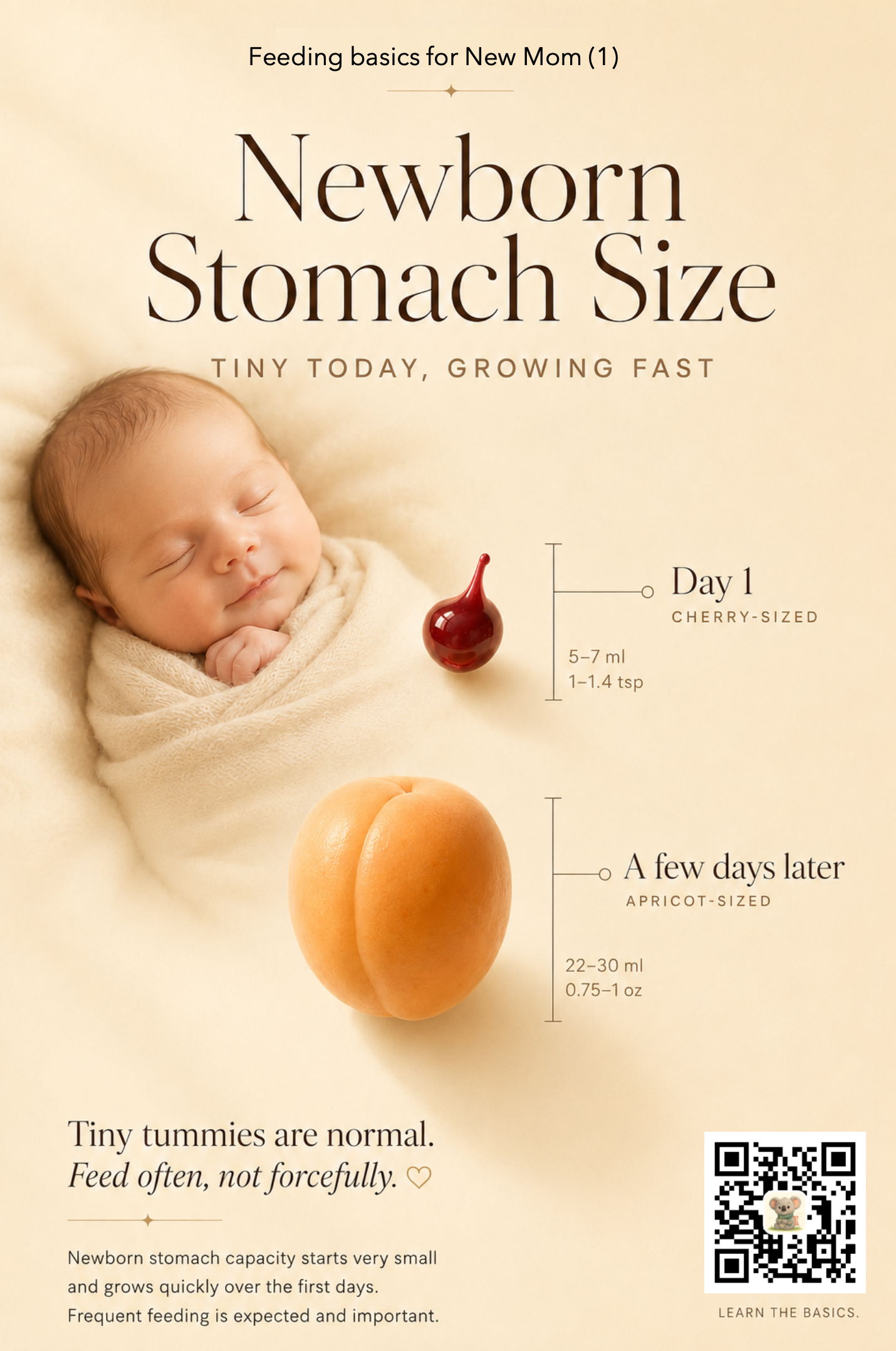
Day-by-day capacity
Pediatric research has measured newborn stomach capacity. The numbers below are commonly cited reference ranges; exact figures vary across studies, but what’s consistent is the small initial capacity and rapid expansion in the first week:
- Day 1: 5–7 ml — cherry-sized. About a teaspoon. The breast produces exactly this much colostrum per feed.
- Day 3: 22–27 ml — walnut-sized. Coincides with milk “coming in.”
- Day 7: 45–60 ml — apricot-sized. Stretchier walls, more volume per feed.
- One month: ~80–150 ml — egg-sized. Feeds become more spaced out.
The system isn’t designed for big meals. It’s designed for small, frequent ones — matched precisely to the supply curve of early colostrum and transitional milk.
Why frequent feeds aren’t a supply problem
A first-time parent who feeds every 90 minutes can easily wonder if their milk is “enough.” The math suggests otherwise. A 6-day-old taking 50 ml every 90 minutes is consuming roughly 16 feeds × 50 ml = 800 ml per day, which lands precisely within the normal range pediatric guidelines cite for breastfed infants in week one.
Frequent isn’t a sign of insufficient supply. It’s a sign the stomach is small and the system is working.
The “is my colostrum enough?” question
Colostrum is dense — about twice the protein concentration of mature milk and packed with immunoglobulins, growth factors, and antibodies. The reason your baby seems satisfied after a teaspoon-sized feed is that a teaspoon of colostrum delivers what they need.
If you’re wondering whether your supply will keep pace as the stomach grows, the answer is almost always yes — provided the baby is feeding on cue and removing milk often. Supply follows demand. Frequent removal in the first weeks builds the supply that will meet the larger stomach later.
Feed on cue, not on the clock
Because newborn stomach capacity is small and digestion is fast, fixed-interval feeding is biologically misaligned. 8–12 feeds per 24 hours is the AAP’s normal range for breastfed newborns — some clustered tightly, some spaced out.
- Watch for early hunger cues: stirring, rooting, hands to mouth.
- Don’t time the previous feed to predict the next one. Watch the baby.
- One unusually long stretch (4+ hours) followed by clustered short feeds is normal day-to-day variation, not a problem.
One last thing
If you’re tracking every minute and worrying you’re feeding too often, zoom out. The most reliable evidence your baby is well-fed isn’t on the clock — it’s in the diaper. We cover that in No. 05.
Sources & further reading
- Bergman, N. J. (2013). Neonatal stomach volume and physiology suggest feeding at 1-h intervals. Acta Paediatrica, 102(8).
- American Academy of Pediatrics. Amount and Schedule of Baby Formula Feedings. HealthyChildren.org.
- World Health Organization & UNICEF. Baby-Friendly Hospital Initiative.
- Riordan, J., & Wambach, K. Breastfeeding and Human Lactation. Jones & Bartlett.
Track every feed, diaper, and sleep — in one calm log.
ParentFlow helps you see your baby’s real rhythm without spreadsheets or guesswork.
Download on App StoreThis article was written against current AAP, CDC, WHO, and IBCLC clinical guidance and is for educational purposes only. It does not constitute medical advice. ParentFlow is a wellness companion — not a substitute for your pediatrician or lactation consultant. For medical concerns, always consult a qualified healthcare provider.
All third-party trademarks, organization names, and publication titles are the property of their respective owners and are referenced under fair use for educational purposes.