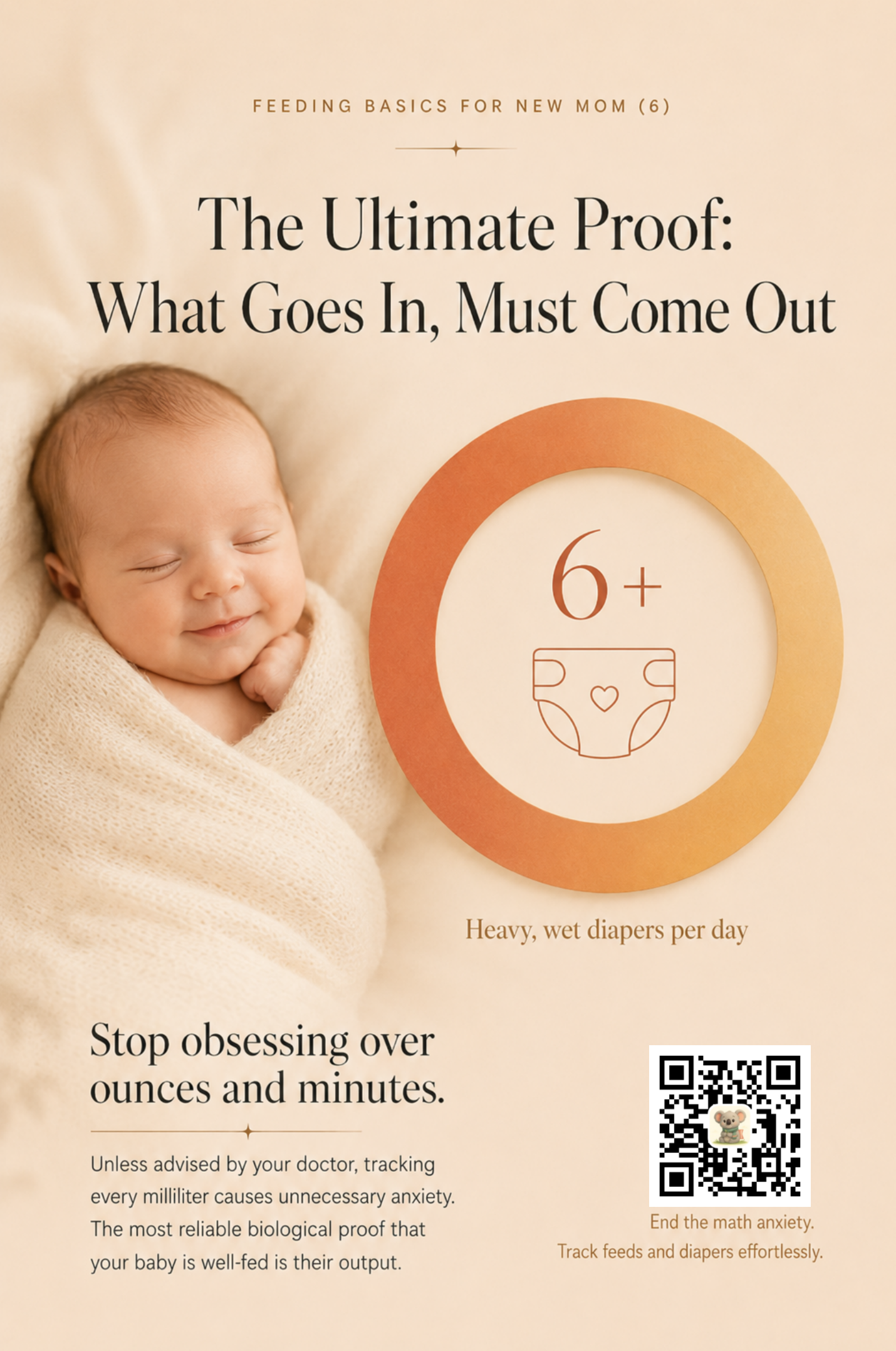
Stop obsessing over ounces and minutes.
The most reliable evidence your baby is well-fed isn’t on a tracker. It’s in the diaper. Six heavy wet diapers a day is the real measure — especially in the first months.
The math-anxiety trap
Modern feeding tracking apps let you log every minute on the breast and every milliliter from a bottle. For some families, this brings peace of mind. For many, it brings the opposite — an anxious math problem that grows nightly.
Strict ounce-counting can backfire in three ways:
- It misses the variability that’s biologically normal — some feeds are small, some are big, and averages over a week matter more than any single feed.
- It elevates cortisol in the feeding parent, which (especially for nursing parents) can interfere with let-down.
- It diverts attention from the more reliable diagnostic: what comes out the other end.
What output actually tells you
Wet and dirty diapers are the most reliable, low-anxiety way to know your baby is getting enough. Pediatric guidelines from the AAP and WHO converge on these references:
- Day 1: 1 wet, 1 dirty (typically meconium — sticky, dark green/black).
- Days 2–3: 2–3 wet, 2–3 dirty. Stools transition to yellow/green.
- Day 4–6: 4–6 wet, 3+ dirty. Stools become yellow, seedy, watery (for breastfed babies).
- Day 7 and beyond: 6 or more heavy wet diapers per day. Dirty diaper frequency varies more — some breastfed babies stool every diaper, some only every few days, and either is fine.
“Heavy” matters. A diaper with just a wet streak doesn’t count. The diaper should feel weighted with at least 3–4 tablespoons of urine.
Weight as the second proof
Pediatricians monitor weight at standard intervals because it’s the gold-standard cumulative measure:
- Newborn checkup (2–5 days). Some weight loss (up to 7%) is normal.
- 2-week checkup. Back to birth weight is the milestone.
- 1-month, 2-month, 4-month checkups. Tracking the curve.
What matters isn’t a particular percentile — it’s consistent movement along the curve. A baby steadily at the 15th percentile is healthier than a baby who drops from the 50th to the 10th.
When ounce counting actually helps
There are real cases where measured intake matters:
- Premature infants or babies discharged from NICU on a feeding plan.
- Babies with slow weight gain whose pediatrician has prescribed measured top-ups.
- Combo-feeding setups where parents want to know breast vs. bottle ratios.
- Returning to work where pumped intake at daycare needs estimation.
Outside these cases, the diaper is the better data source. End the math anxiety.
One last thing
If counting ounces is helping you feel calm, keep doing it. If it’s the source of dread, drop it — and trust the diaper count instead. Your weekly weigh-in tells the rest.
Sources & further reading
- American Academy of Pediatrics. Diapers and Clothing.
- World Health Organization. Child Growth Standards.
- Wambach, K., & Riordan, J. Breastfeeding and Human Lactation. Jones & Bartlett.
- Flaherman, V. J., et al. (2015). Newborn weight loss during birth hospitalization. Pediatrics, 135(1).
Track every feed, diaper, and sleep — in one calm log.
ParentFlow helps you see your baby’s real rhythm without spreadsheets or guesswork.
Download on App StoreThis article was written against current AAP, CDC, WHO, and IBCLC clinical guidance and is for educational purposes only. It does not constitute medical advice. ParentFlow is a wellness companion — not a substitute for your pediatrician or lactation consultant. For medical concerns, always consult a qualified healthcare provider.
All third-party trademarks, organization names, and publication titles are the property of their respective owners and are referenced under fair use for educational purposes.