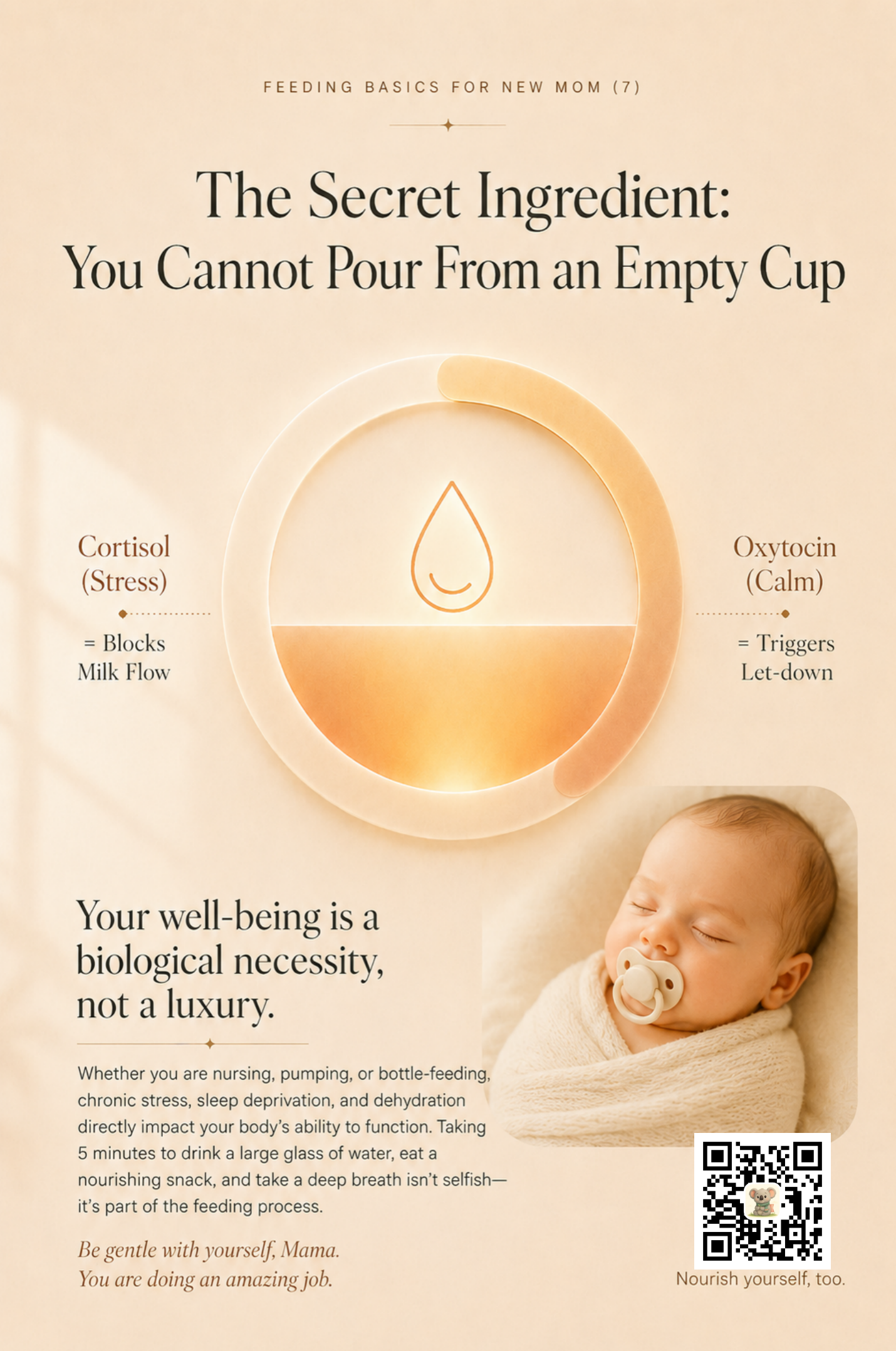
You cannot pour from an empty cup.
Cortisol blocks milk flow. Oxytocin triggers let-down. Your stress level is part of your feeding equation — which means your wellness isn’t a luxury. It’s part of the care plan.
The biology of let-down
Milk leaves the breast through a hormone-controlled reflex called let-down (or milk ejection reflex). The mechanism:
- Baby latches and begins suckling — or even hears, sees, or thinks of the baby.
- Nerve signals reach the hypothalamus.
- The posterior pituitary releases oxytocin.
- Oxytocin causes the smooth muscle around milk-producing alveoli to contract.
- Milk flows out into the ducts and to the nipple.
The whole reflex takes 30 seconds to 2 minutes. Without it, very little milk leaves the breast — even a fully stocked, perfectly latched system.
What blocks oxytocin
Oxytocin and cortisol have an inverse relationship. When stress hormones are high, oxytocin release is dampened. The most common blockers:
- Acute stress. An argument, a phone call you dread, financial worry, family tension.
- Pain. Cracked nipples, post-Cesarean recovery, mastitis — any active pain elevates cortisol.
- Dehydration and hunger. Your body de-prioritizes lactation when your own basics are unmet.
- Multitasking. Trying to feed while answering emails, scrolling, or watching news divides nervous system attention.
- Performance pressure. “Why isn’t the milk coming?” itself raises cortisol, creating a feedback loop.
This is why some parents notice they let down freely with their baby but not with a pump. Pumps don’t trigger oxytocin the same way.
The 5-minute intervention
Most let-down disruption is reversible in five minutes. The intervention isn’t expensive and isn’t complicated:
- A large glass of water. Cool, slow, before the feed.
- A nourishing snack. Something with protein and fat — nuts, cheese, peanut butter on toast. Not just a granola bar.
- Three deep breaths. Slow inhale, longer exhale. This activates the parasympathetic nervous system, which is permissive of oxytocin.
- Dim the lights. Reduce sensory load.
- Skin-to-skin. Even a few minutes before latching triggers oxytocin release.
None of these are luxuries. They’re part of the feeding mechanism.
Sleep, stress, and supply
The cumulative impact of weeks of broken sleep, dehydration, and unresolved stress isn’t just a feeding-session problem. Over time it lowers baseline supply. Many parents who describe their supply “tanking” around the 6–8 week mark are experiencing the lagging effect of compounded stress, not a sudden biological failure.
This is why supporting the feeding parent — meals, hydration, a protected sleep block (see our Mom Sleep article), help with the household — is not pampering. It’s infrastructure.
One last thing
Your wellness is biology, not a hobby. Treating mom-care as part of baby-care is the most evidence-based parenting move of the first six months. Be gentle with yourself, Mama. You are doing an amazing job.
Sources & further reading
- Postpartum Support International. postpartum.net. Helpline: 1-800-944-4773.
- Uvnäs-Moberg, K. (1998). Oxytocin may mediate the benefits of positive social interaction and emotions. Psychoneuroendocrinology, 23(8).
- Dewey, K. G. (2001). Maternal and fetal stress are associated with impaired lactogenesis in humans. Journal of Nutrition, 131(11).
- American College of Obstetricians and Gynecologists. Postpartum Depression FAQ.
Track every feed, diaper, and sleep — in one calm log.
ParentFlow helps you see your baby’s real rhythm without spreadsheets or guesswork.
Download on App StoreThis article was written against current AAP, CDC, WHO, and IBCLC clinical guidance and is for educational purposes only. It does not constitute medical advice. ParentFlow is a wellness companion — not a substitute for your pediatrician or lactation consultant. For medical concerns, always consult a qualified healthcare provider.
All third-party trademarks, organization names, and publication titles are the property of their respective owners and are referenced under fair use for educational purposes.