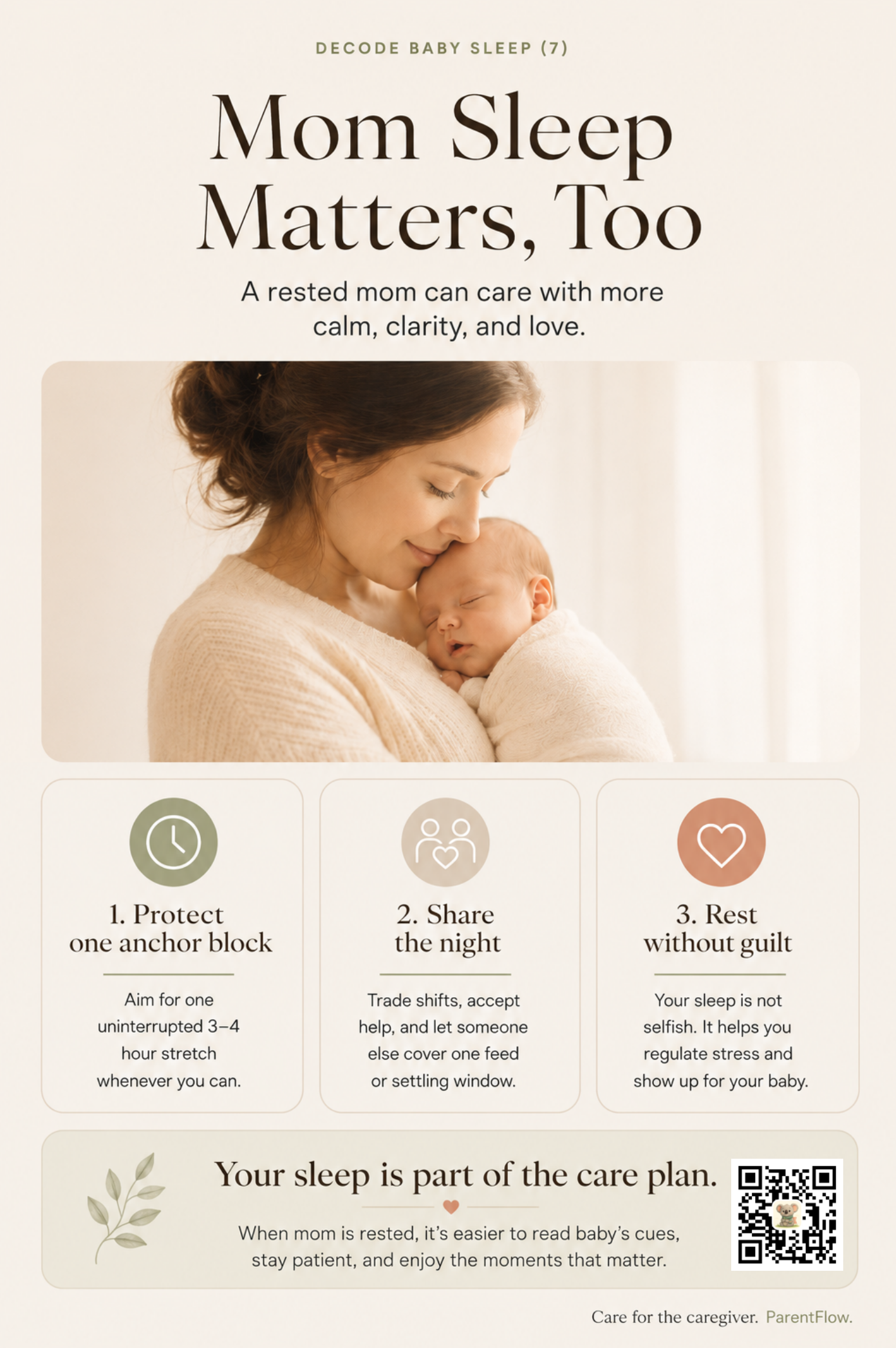
Mom sleep matters, too.
A rested mom shows up calmer, more patient, more present. Your sleep isn’t a luxury — it’s biology, and it belongs in the care plan alongside feeding and changing.
What sleep deprivation does to a parent
The first three months of parenthood involve sleep that’s not just shorter but fragmented — a different kind of cost than simply staying up late. Research on shift workers and on new mothers consistently shows that fragmented sleep:
- Reduces cognitive performance, decision-making, and reaction time. (Studies of sustained wakefulness — e.g., Williamson & Feyer, 2000 — show 17–19 hours awake impairs reaction time comparably to a blood alcohol level of 0.05. Severely fragmented postpartum sleep affects cognition through a related but distinct mechanism.)
- Elevates cortisol, which makes emotional regulation harder and can prolong postpartum anxiety.
- Increases inflammation and slows physical recovery from childbirth.
- Substantially raises risk of postpartum mood disorders.
None of this is your fault. It’s the predictable cost of biology meeting a body that just gave birth. The fix isn’t willpower — it’s structural.
The anchor block strategy
One of the best-evidenced interventions for new-parent sleep is protecting one consolidated 3–4 hour block per 24 hours. Research on parental sleep shows that one continuous block is dramatically more restorative than the same total hours spread across many short stretches.
How to find one:
- Identify your worst circadian window. For most adults, sleep between roughly 10 p.m. and 2 a.m. is the deepest and most restorative. Protect that window for the parent who needs it most.
- Have a partner, family member, or postpartum doula cover that block. If you’re breastfeeding, pump a single bottle in advance, or use formula for that one feed.
- Sleep in a different room if needed. The other parent stays with the baby. Yes, this is OK. It’s also temporary.
Sharing the night
A common arrangement for two-parent households:
- 9 p.m.–2 a.m. — Parent A on duty. Parent B sleeps with earplugs in a different room or with white noise.
- 2 a.m.–7 a.m. — Swap. Parent B on duty. Parent A gets the protected morning stretch.
For nursing parents who want to avoid heavy formula use, a pumped bottle for the 2 a.m. feed is often the difference between exhausted and functional. The supply impact of one missed nursing session is minimal once supply is established.
Solo parents: lean harder on family, friends, postpartum doulas, or paid help for the anchor block. It’s not a luxury — it’s a health intervention. If you can find one regular helper for two evenings a week, do it.
Postpartum mood + sleep — warning signs
Some sleep symptoms are signs of normal parenthood. Others are signals to call your provider:
- Can’t sleep even when baby is sleeping. Especially with racing thoughts, dread, or hypervigilance — this is often postpartum anxiety, which is highly treatable.
- Mood that doesn’t lift after a good stretch. Postpartum blues should resolve within ~2 weeks of birth. Persistent low mood, hopelessness, or numbness past that warrants a conversation with your OB or primary care provider.
- Intrusive thoughts. If you experience distressing, unwanted thoughts about harm coming to your baby, you are not alone — research shows these are surprisingly common in postpartum and not a sign you’re a bad parent. They’re a sign your nervous system is overloaded — and they’re treatable.
- Any thought of harming yourself or your baby that feels real or planned. Call your provider or a crisis line immediately.
Postpartum Support International maintains a free helpline (1-800-944-4773) staffed by trained volunteers and clinicians. Calling does not put you on any record. It’s a resource.
One last thing
You don’t earn the right to sleep by doing more. You sleep because the system depends on you, and the system depends on you because you sleep. Treat your sleep as load-bearing — not optional — and let everyone around you treat it that way too.
Sources & further reading
- Postpartum Support International. postpartum.net. Free helpline: 1-800-944-4773.
- American Academy of Pediatrics. Perinatal Mental Health and Social Support.
- McQuillan, M. E., Bates, J. E., Staples, A. D., & Deater-Deckard, K. (2019). Maternal stress, sleep, and parenting. Journal of Family Psychology, 33(3).
- Bei, B., Coo, S., & Trinder, J. (2015). Sleep and mood during pregnancy and the postpartum period. Sleep Medicine Clinics, 10(1).
- American College of Obstetricians and Gynecologists. Postpartum Depression FAQ.
Track every feed, nap, and night-wake — in one calm log.
ParentFlow helps you spot the rhythm of your baby’s sleep without spreadsheets or guesswork.
Download on App StoreThis article was written against current AAP, CDC, WHO, and IBCLC clinical guidance and is for educational purposes only. It does not constitute medical advice. ParentFlow is a wellness companion — not a substitute for your pediatrician. For medical concerns, always consult a qualified healthcare provider.
All third-party trademarks, organization names, and publication titles are the property of their respective owners and are referenced under fair use for educational purposes.