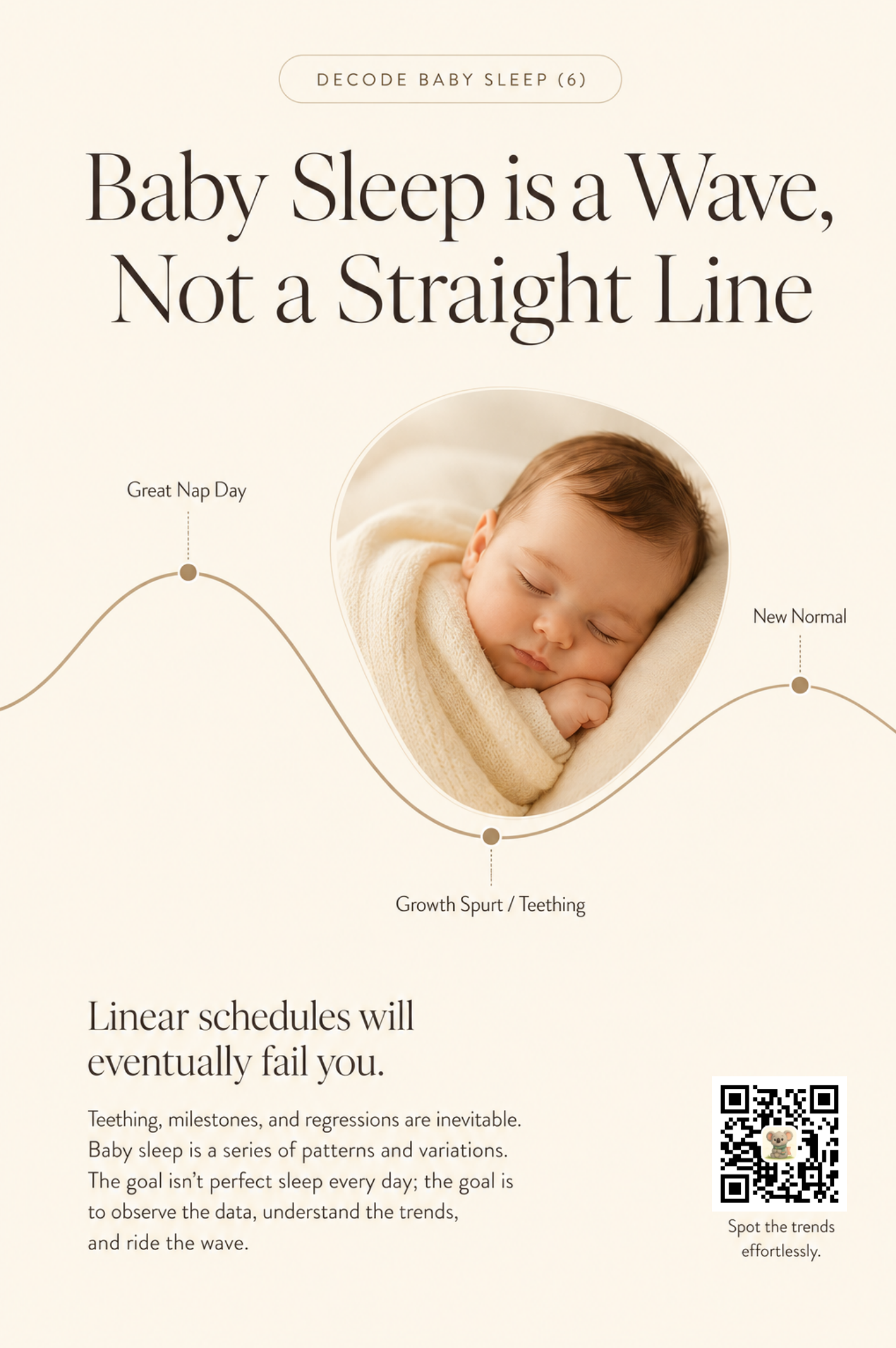
Baby sleep is a wave, not a straight line.
Teething, milestones, growth spurts, illness, travel — they all come. The goal isn’t perfect sleep every night. It’s spotting the pattern and learning to ride the wave.
Why linear schedules eventually fail
Every fixed sleep schedule is a snapshot of one developmental moment. Babies don’t stay there. The schedule that worked beautifully at 5 months has a near-certain expiration date at 6 months, when the next leap arrives.
The most reliable predictor of sleep frustration in the first two years is the expectation of a permanent schedule. The most reliable predictor of sleep peace is treating the schedule as a current snapshot — useful, valid, and temporary.
The major waves to expect
Sleep disruptions cluster around developmental shifts. Most aren’t random:
- 3–6 weeks. Growth spurt. More feeding, fragmented sleep, increased evening fussing.
- 4 months. Sleep architecture matures. Often the first true regression.
- 6 months. Solid food introduction, often a growth spurt, sometimes teething.
- 8–10 months. Separation anxiety emerges. Mobility milestones (crawling, pulling up).
- 12 months. Walking, vocabulary explosion, sometimes the morning nap dropping.
- 18 months. Language leap, often combined with first molars.
- 2 years. Imagination, fears, sometimes nap dropping entirely.
None of these are universal — some babies sail through them. But knowing they exist makes a sudden bad week feel like weather, not a crisis.
Patterns over points
The single highest-value habit in the first two years is logging sleep weekly, not daily. Day-by-day data is noise. Week-over-week data is signal.
- Total sleep in 24 hours. Aim for the appropriate range for your baby’s age (newborns 14–17 hr; 4–11 mo 12–15 hr; 1–2 yr 11–14 hr per AAP).
- Number of night wake-ups. Track the average over a week. Two bad nights in a generally good week is weather. Two bad weeks in a row is a pattern.
- Longest sleep stretch. This number tells you whether your baby is consolidating, even if the total is unchanged.
What you’re looking for isn’t a perfect chart. It’s a trend — up or down, week over week.
What “good enough” sleep looks like
The internet’s version of good baby sleep is unrealistic for the first 12–18 months. Real good-enough sleep looks like:
- A consolidated overnight stretch that grows over months (4 hours at 8 weeks, 6 at 4 months, 8–10 at 6–9 months, longer with luck).
- Predictable naps within a range — not exactly to the minute.
- Recovery within a week after a disruption (illness, travel, teething).
- Weight gain on track. Mood mostly even. Engagement during awake time.
If those things are mostly true, your baby’s sleep is working. The 7-p.m.-to-7-a.m. unbroken night is not the bar — and chasing it can make everything worse.
One last thing
If you’re tracking sleep on a granular daily basis and feeling defeated — zoom out. Look at this week vs. last month. The wave is almost always moving in the right direction, even when today feels like a step back.
Sources & further reading
- Paruthi, S., Brooks, L. J., D’Ambrosio, C., et al. (2016). Consensus statement of the American Academy of Sleep Medicine on the recommended amount of sleep for pediatric populations. Journal of Clinical Sleep Medicine, 12(6).
- American Academy of Pediatrics. Healthy Sleep Habits: How Many Hours Does Your Child Need?
- Sadeh, A., Mindell, J. A., Luedtke, K., & Wiegand, B. (2009). Sleep and sleep ecology in the first 3 years: a web-based study. Journal of Sleep Research, 18(1).
- Galland, B. C., Taylor, B. J., et al. (2012). Normal sleep patterns in infants and children: a systematic review. Sleep Medicine Reviews, 16(3).
Track every feed, nap, and night-wake — in one calm log.
ParentFlow helps you spot the rhythm of your baby’s sleep without spreadsheets or guesswork.
Download on App StoreThis article was written against current AAP, CDC, WHO, and IBCLC clinical guidance and is for educational purposes only. It does not constitute medical advice. ParentFlow is a wellness companion — not a substitute for your pediatrician. For medical concerns, always consult a qualified healthcare provider.
All third-party trademarks, organization names, and publication titles are the property of their respective owners and are referenced under fair use for educational purposes.