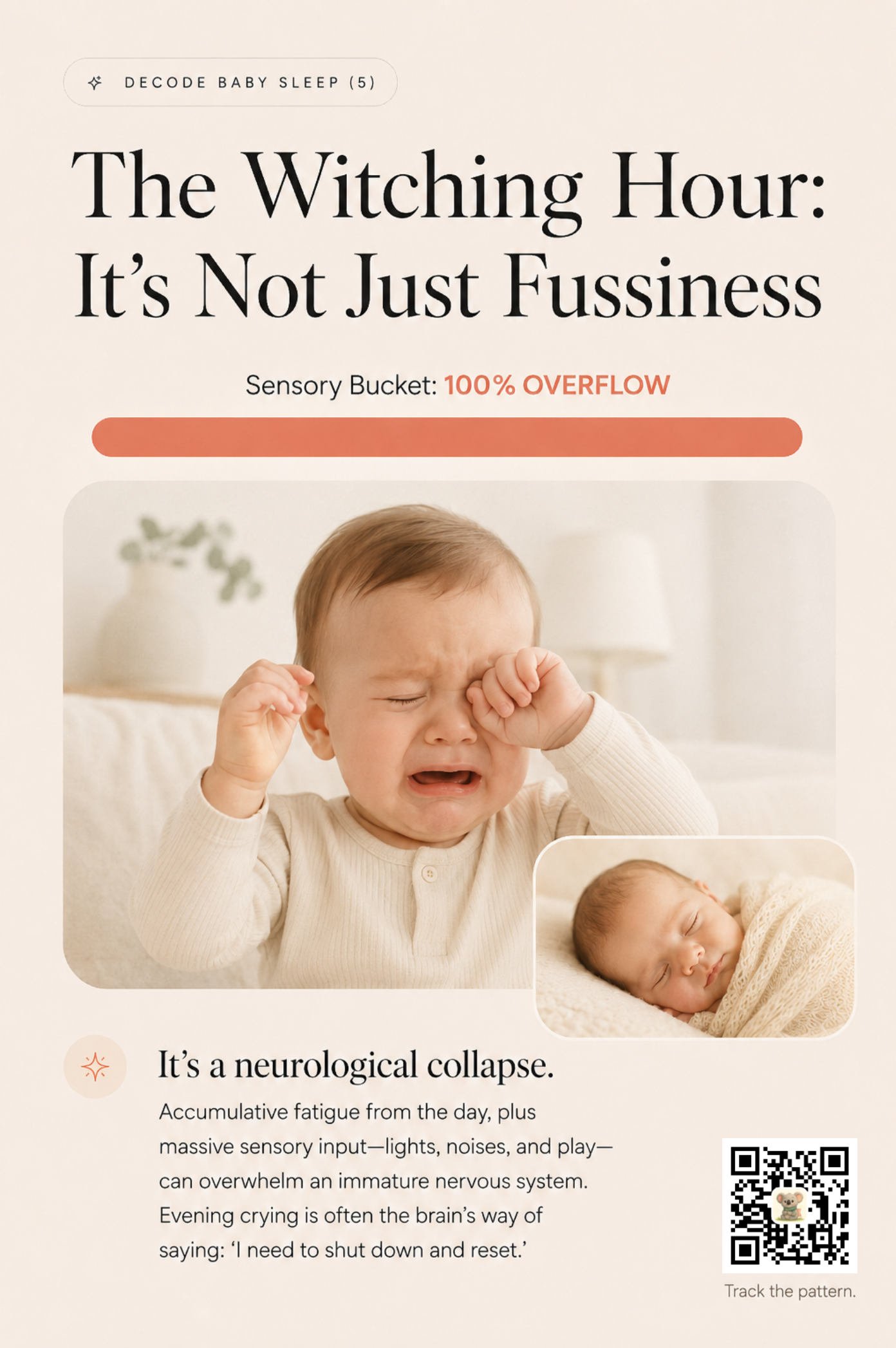
The witching hour isn’t just fussiness.
By 5 p.m., a newborn’s sensory bucket is overflowing. The evening crying that defines weeks 2–12 is often neurological collapse, not temperament. Here’s how to dim the room before the storm arrives.
The sensory bucket is real
Newborns can’t filter sensory input the way older children and adults can. Every sight, sound, smell, touch, and social interaction goes into what pediatric researchers sometimes describe as a sensory bucket. The bucket has finite capacity.
By late afternoon, after a full day of being held, talked to, fed, changed, looked at, and exposed to light and sound, the bucket overflows. The result is what most parents recognize as the witching hour: unstoppable crying, refusal to be soothed, frantic energy that doesn’t match the day’s events.
Why it concentrates in the evening
The witching hour isn’t random. Multiple factors converge between 4 p.m. and 9 p.m.:
- Accumulated fatigue. Each nap window has been a little harder than the last, even if you didn’t notice. Cortisol has crept up. (See why overtired babies can’t sleep.)
- Cluster-feed biology. Breastfed babies often cluster-feed in the evening, both for the calorie boost before the longest sleep stretch and to signal supply for tomorrow.
- Dropping core temperature. Evening triggers a small drop in body temperature, which is a sleep cue — but it also makes a stimulated baby more reactive.
- Parental fatigue. You’re also tired. Babies pick up on tension and dysregulation in the people holding them.
How to dim before the storm
The witching hour is not always preventable, but it’s usually manageable. The key is to start before the bucket overflows:
- Begin dimming at 4 p.m. Lower the lights, close blinds, turn off background music or TV.
- Reduce handling. Limit visitors, photos, and passing-around. Put the baby down in a low-input environment more often.
- Move to a quiet room. One adult, one baby, white noise on, swaddle ready.
- Anchor a 5 p.m. ritual. Same time, same place, same sequence. Even a 10-minute walk in the carrier counts. Predictability discharges the bucket gradually.
- Plan a reset feed. Many babies need an extra short feed during the witching hour even if the clock says they’re not due.
When fussing becomes colic
Pediatric guidelines define colic using the “rule of 3s”: at least 3 hours of crying per day, on at least 3 days per week, for at least 3 weeks, in an otherwise healthy and well-fed baby. Roughly 20% of babies meet this definition.
Colic typically begins around 2–3 weeks of age, peaks at 6 weeks, and resolves by 3–4 months. It’s exhausting and disorienting for parents, but it does end.
If your baby’s crying meets the rule of 3s, call your pediatrician. They’ll rule out reflux, food intolerance, and other treatable conditions, and may suggest probiotics (some evidence supports L. reuteri) or a brief trial of changes in feeding.
One last thing
The witching hour is one of the hardest, lonelier hours of new parenthood. It’s also one of the most predictable. Around 12 weeks, when sensory regulation matures and routines start to stick, it begins to lift — usually without you doing anything different. It’s a stage. You’re not failing it.
Sources & further reading
- Wessel, M. A., Cobb, J. C., Jackson, E. B., Harris, G. S., & Detwiler, A. C. (1954). Paroxysmal fussing in infancy, sometimes called “colic.” Pediatrics, 14(5).
- American Academy of Pediatrics. Colic Relief Tips for Parents.
- Sung, V., et al. (2018). Lactobacillus reuteri to Treat Infant Colic: A Meta-analysis. Pediatrics, 141(1):e20171811.
- Karp, H. The Happiest Baby on the Block.
Track every feed, nap, and night-wake — in one calm log.
ParentFlow helps you spot the rhythm of your baby’s sleep without spreadsheets or guesswork.
Download on App StoreThis article was written against current AAP, CDC, WHO, and IBCLC clinical guidance and is for educational purposes only. It does not constitute medical advice. ParentFlow is a wellness companion — not a substitute for your pediatrician. For medical concerns, always consult a qualified healthcare provider.
All third-party trademarks, organization names, and publication titles are the property of their respective owners and are referenced under fair use for educational purposes.