The 4-month regression is actually a progression.
Around 16 weeks, baby sleep architecture matures permanently. Cycles drop from continuous chunks to mature 90-minute waves. It feels like backsliding — it’s the leap that finally makes lasting sleep changes possible.
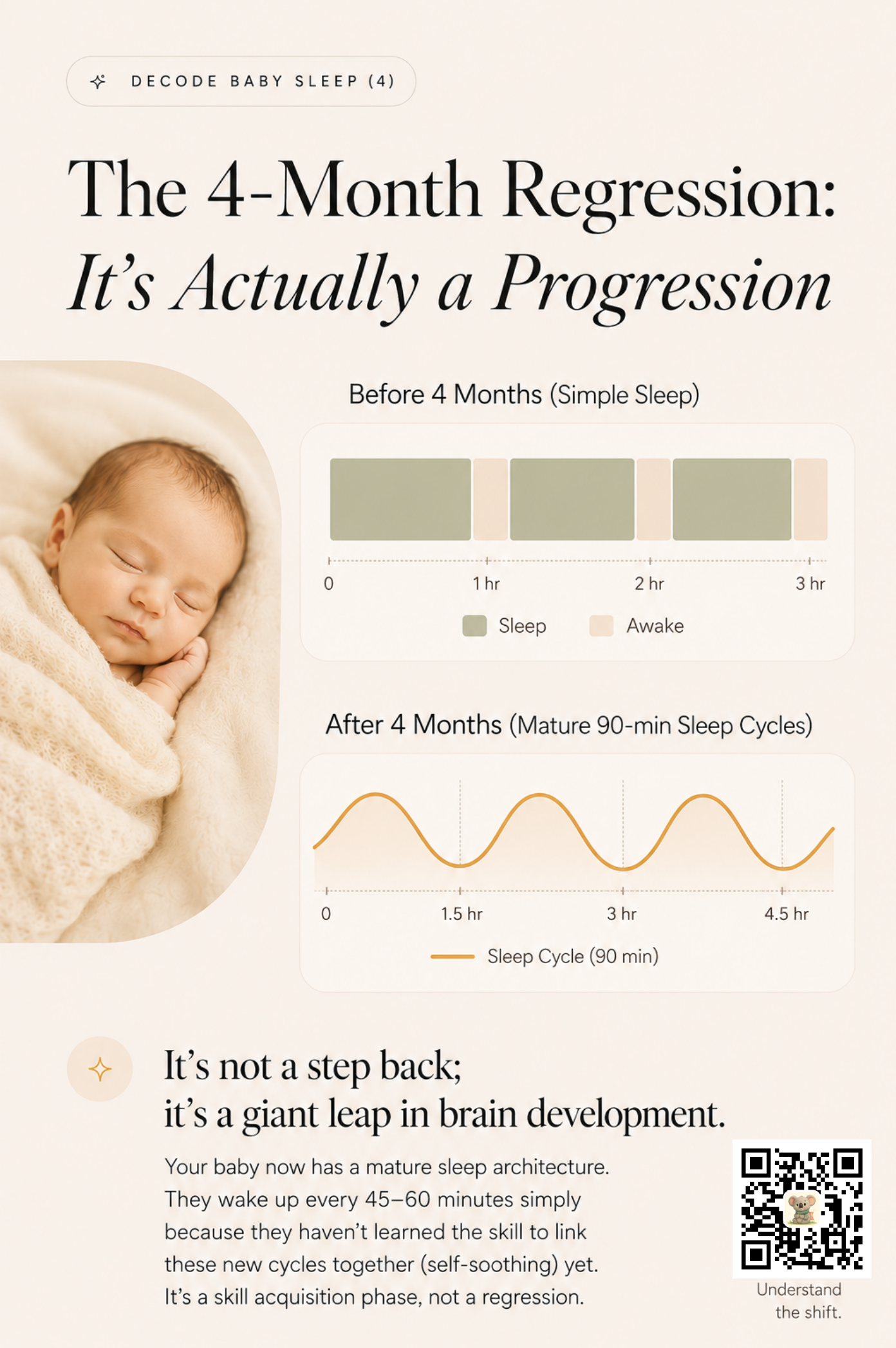
What actually changes at 4 months
Before about 16 weeks, your baby’s sleep is structurally different from adult sleep. They have only two stages — active sleep (REM-like) and quiet sleep — and cycles last roughly 50 minutes. Most of the night is spent in active sleep, which is light and easily disturbed.
Around the 4-month mark, this changes permanently. The brain develops the four-stage adult sleep cycle: N1 (drowsy), N2 (light sleep), N3 (deep sleep), and REM. Cycles lengthen to about 90 minutes. This is a one-way developmental gate — you can’t go back.
Why it feels like a regression
Adult sleep includes brief, almost-conscious awakenings between every cycle. We turn over, check our pillow, and fall back asleep without remembering it. We’ve had decades of practice.
Your baby, brand new to mature sleep cycles, doesn’t know how to do this yet. So at the boundary between every 90-minute cycle, they wake up fully — about every 45–90 minutes — and don’t know how to put themselves back to sleep.
From the outside, it looks like overnight sleep collapsed. From the inside, the architecture upgraded, and the baby hasn’t learned the new operating manual.
Self-soothing is a learnable skill
Self-soothing — the ability to fall back asleep without external help — is a skill, not a personality trait. Some babies pick it up on their own. Most need some support.
Multiple methods have research backing:
- Gentle / fading methods. Stay in the room, gradually reduce intervention over weeks. Slow, low-stress, takes longer.
- Check-and-console (Ferber-style). Brief, timed check-ins. Most published results in 3–7 nights.
- Extinction (cry-it-out). Place down awake, don’t return until the next feed. Fastest, hardest on parents. Long-term follow-up studies (notably Gradisar et al., 2016) have not shown evidence of harm in studied populations, though clinicians and families weigh values differently here.
The right method is the one you can be consistent with for at least 2 weeks. Inconsistency is more disruptive than any single method.
How to support without forcing
If you’re not ready for formal sleep training — or your pediatrician advises waiting — you can still support the transition:
- Slightly extended last wake window. Adding 15–30 minutes to the pre-bedtime stretch builds sleep pressure and helps the longer sleep cycle land.
- Consistent bedtime routine. Three or four steps in the same order: bath, lotion, swaddle/sleep sack, feed, song. Routine becomes a cue.
- Put down drowsy but awake. Even once. The skill is built by practicing the transition from awake to asleep in the crib.
- Patience. Most 4-month regressions resolve in 2–6 weeks, with or without active training.
One last thing
The first time you put your baby down for a nap and they fall asleep on their own — this is the moment all the architecture stuff stops being theory. The cycle they couldn’t link last month, they now link. The skill arrives. Often when you’ve given up trying.
Sources & further reading
- Mindell, J. A., Kuhn, B., Lewin, D. S., Meltzer, L. J., & Sadeh, A. (2006). Behavioral treatment of bedtime problems and night wakings in infants and young children. Sleep, 29(10).
- Gradisar, M., Jackson, K., Spurrier, N. J., et al. (2016). Behavioral interventions for infant sleep problems: a randomized controlled trial. Pediatrics, 137(6).
- American Academy of Pediatrics. Getting Your Baby to Sleep.
- Mindell, J. A., & Owens, J. A. A Clinical Guide to Pediatric Sleep.
Track every feed, nap, and night-wake — in one calm log.
ParentFlow helps you spot the rhythm of your baby’s sleep without spreadsheets or guesswork.
Download on App StoreThis article was written against current AAP, CDC, WHO, and IBCLC clinical guidance and is for educational purposes only. It does not constitute medical advice. ParentFlow is a wellness companion — not a substitute for your pediatrician. For medical concerns, always consult a qualified healthcare provider.
All third-party trademarks, organization names, and publication titles are the property of their respective owners and are referenced under fair use for educational purposes.