Newborn sleep: no clock, only instinct.
Melatonin production doesn’t begin until around week 8. Circadian rhythm doesn’t fully mature until 4 months. Until then, your baby sleeps because their body is tired — not because it’s nighttime.
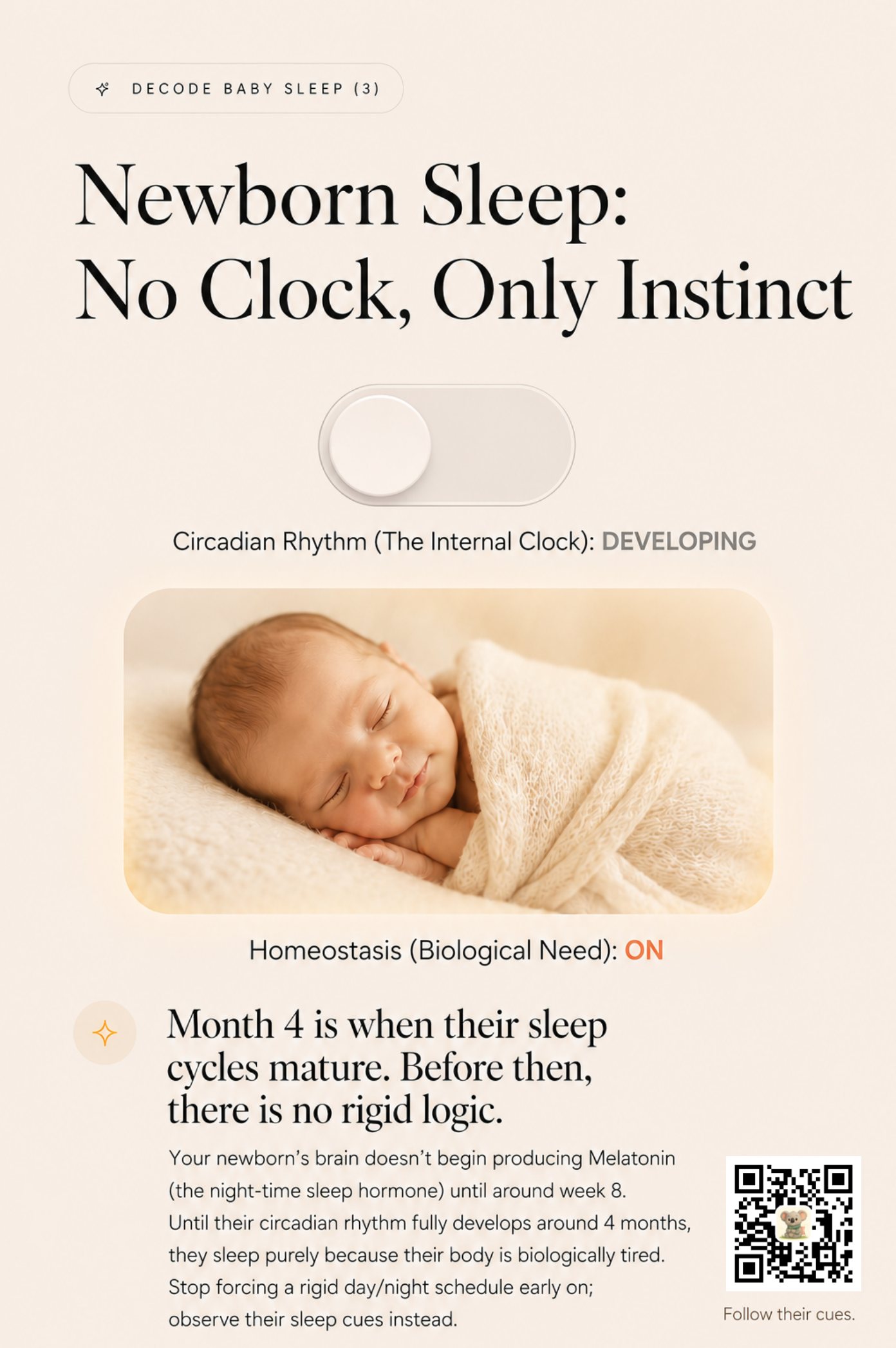
Two systems — one is offline at birth
Sleep in humans runs on two parallel systems:
- Homeostasis — the sleep-pressure mechanism. The longer you’ve been awake, the more adenosine builds up, and the more your body asks for sleep. This system works from birth.
- Circadian rhythm — the 24-hour clock that says “night = sleep, day = wake.” This system is governed by the suprachiasmatic nucleus and the hormone melatonin. It is not yet wired in newborns.
For roughly the first 8–12 weeks of life, your baby has homeostasis but not circadian rhythm. They sleep when tired, regardless of the wall clock.
When does melatonin start?
Pineal melatonin secretion begins around week 8–12 of life and rises gradually through month 3. Until then, your baby’s body doesn’t produce the hormone that signals “sleep now.”
This is why “day-night confusion” is not a problem to solve in the first weeks — it’s the biological default. Your baby isn’t confused. The system that distinguishes day from night simply hasn’t booted yet.
Why strict schedules fail before 4 months
By around 16 weeks, sleep cycles mature, circadian rhythm strengthens, and melatonin secretion is well established. Before that, three things make a strict schedule counterproductive:
- Sleep cycles are short and unstructured. Newborn cycles are ~50 minutes vs. mature 90-minute cycles. Trying to enforce a long, predictable nap fails because the cycle isn’t long enough.
- Hunger drives most wake-ups. Stomach capacity is tiny. Forcing “sleep schedules” before feed schedules are stable disrupts both.
- Sensory regulation is the priority. The newborn nervous system is still learning to filter input. Adding structure too soon adds another input to filter.
What to do instead
The goal in the first 12 weeks isn’t a schedule — it’s the conditions that help circadian rhythm emerge:
- Bright light during day feeds. Open the curtains. Take the baby outside for short walks. Daylight is the primary entrainer of circadian rhythm.
- Dim, quiet, brief night feeds. Red or amber light only. Minimal eye contact, minimal talking. You’re training the brain that night = no engagement.
- Cue-based feeding and sleeping. Feed when hungry, sleep when tired, in any order, day or night.
- Gentle anchoring at 3–4 months. Around the time melatonin and circadian rhythm mature, you can introduce a consistent wake time and bedtime. Before that, anchoring fights biology.
One last thing
If you’re trying to enforce a schedule on a 4-week-old and feeling like you’re failing — you’re not. You’re trying to run software on hardware that hasn’t shipped yet. Wait for the system to come online. It will, somewhere around week 12.
Sources & further reading
- Rivkees, S. A. (2003). Developing circadian rhythmicity in infants. Pediatrics, 112(2).
- McGraw, K., Hoffmann, R., Harker, C., & Herman, J. H. (1999). The development of circadian rhythms in a human infant. Sleep, 22(3).
- American Academy of Pediatrics. Healthy Sleep Habits: How Many Hours Does Your Child Need?
- Karp, H. The Happiest Baby on the Block. Bantam Books.
Track every feed, nap, and night-wake — in one calm log.
ParentFlow helps you spot the rhythm of your baby’s sleep without spreadsheets or guesswork.
Download on App StoreThis article was written against current AAP, CDC, WHO, and IBCLC clinical guidance and is for educational purposes only. It does not constitute medical advice. ParentFlow is a wellness companion — not a substitute for your pediatrician. For medical concerns, always consult a qualified healthcare provider.
All third-party trademarks, organization names, and publication titles are the property of their respective owners and are referenced under fair use for educational purposes.