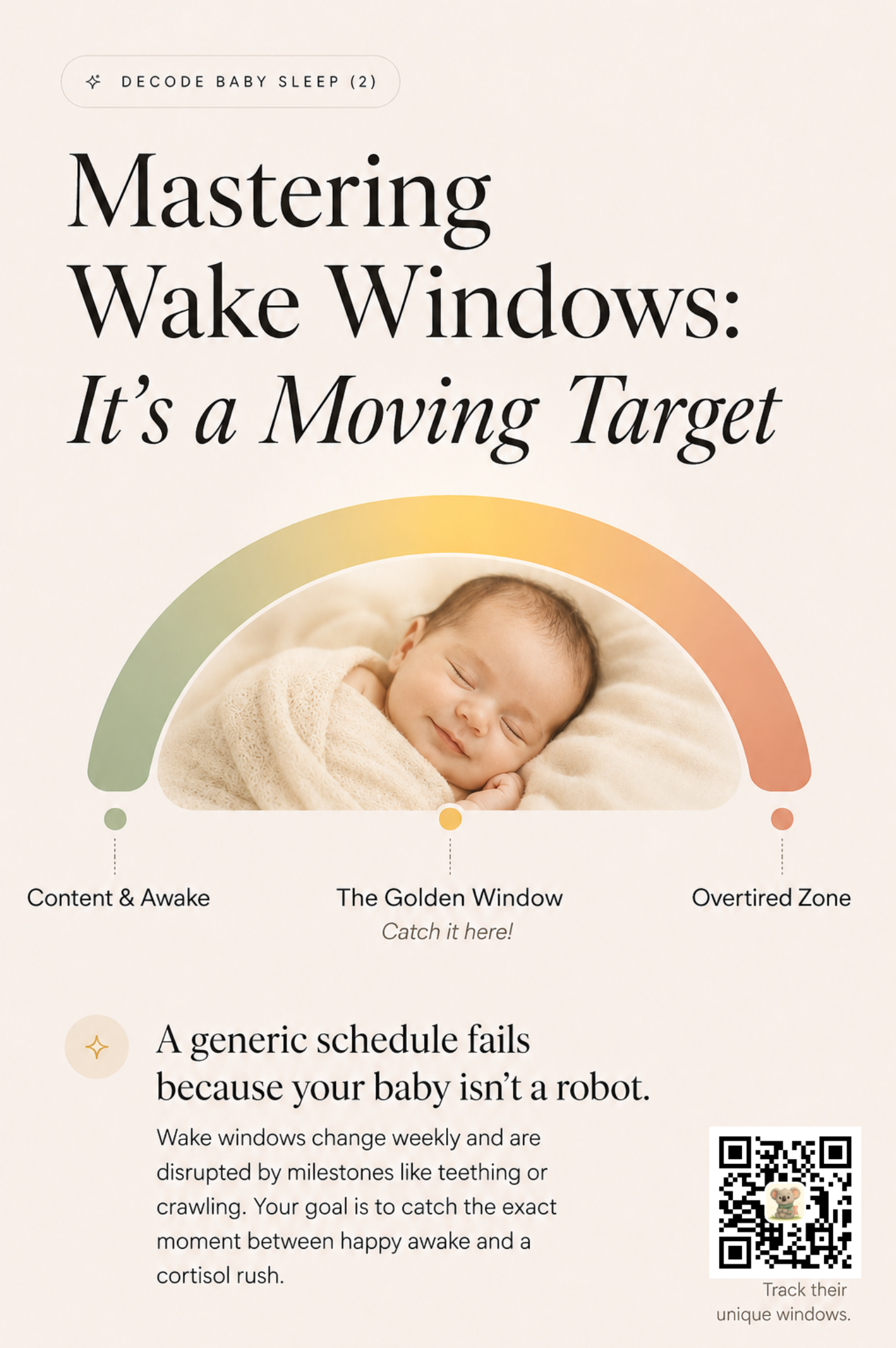
Wake windows are a moving target.
There’s no fixed wake window for any age. It shifts weekly, scrambles around teething and milestones, and looks different on a great-nap day than after a short night. Here’s how to find your baby’s — not a textbook’s.
What a wake window is — and isn’t
A wake window is the stretch of time between waking from one sleep and being ready for the next. It’s not a setting you dial in. It’s the result of two competing forces: sleep pressure (the chemical build-up that makes us drowsy) and circadian phase (where your baby is in their 24-hour cycle).
That’s why a single number on a chart is never right. The window after a 30-minute nap is shorter than the window after a 2-hour nap. The window in the morning is shorter than the window before bedtime. And the window at week 8 is different from the window at week 10.
Why it changes every week
Three forces keep wake windows moving:
- Sleep architecture maturation. Cycles lengthen and become more structured between birth and roughly 6 months.
- Developmental leaps. Rolling, sitting, crawling, pulling-to-stand, walking, talking — each one temporarily disrupts sleep timing.
- Feeding consolidation. As feeds drop and become more spaced out, naps re-organize around them.
What this means in practice: a wake window that worked last Tuesday may be wrong this Tuesday. Treat the chart below as a reference range, not a prescription.
Reference ranges by age
Approximate ranges from pediatric sleep medicine. Your baby may sit anywhere within them — or just outside.
- Newborn (0–6 weeks): 45–60 minutes
- 6–12 weeks: 60–90 minutes
- 3–5 months: 90–150 minutes (the “golden window” matures here)
- 6–9 months: 2–3 hours
- 9–12 months: 3–4 hours
- 12–18 months: 4–5 hours (the morning nap usually drops in this range)
- 18 months–3 years: 5–6 hours (one afternoon nap)
The last wake window before bedtime is usually longer than the others by 30–60 minutes. This is normal and helps build sleep pressure for the longest sleep stretch.
Read the baby, not the clock
The single best diagnostic isn’t a chart — it’s the cue. If your baby is showing sleep-ready cues 20 minutes earlier than the chart says, trust the cues. The chart is a population average. Your baby is a sample of one.
- Log for a week. Note time woke, time put down, time fell asleep, time woke again. Patterns emerge fast.
- Find your average. The number you see most often is your baby’s current wake window.
- Adjust weekly, not daily. One off day isn’t a signal. Three off days in a row is.
One last thing
The wake-window chart you saved on Pinterest was built from someone else’s baby. Your baby’s rhythm is in your tracking log — not the chart. The chart is the starting estimate; your data is the truth.
Sources & further reading
- Mindell, J. A., & Owens, J. A. A Clinical Guide to Pediatric Sleep. Lippincott Williams & Wilkins.
- American Academy of Pediatrics. Healthy Sleep Habits for Babies.
- Galland, B. C., Taylor, B. J., Elder, D. E., & Herbison, P. (2012). Normal sleep patterns in infants and children: a systematic review of observational studies. Sleep Medicine Reviews, 16(3).
- Iglowstein, I., Jenni, O. G., et al. (2003). Sleep duration from infancy to adolescence: reference values and generational trends. Pediatrics, 111(2).
Track every feed, nap, and night-wake — in one calm log.
ParentFlow helps you spot the rhythm of your baby’s sleep without spreadsheets or guesswork.
Download on App StoreThis article was written against current AAP, CDC, WHO, and IBCLC clinical guidance and is for educational purposes only. It does not constitute medical advice. ParentFlow is a wellness companion — not a substitute for your pediatrician. For medical concerns, always consult a qualified healthcare provider.
All third-party trademarks, organization names, and publication titles are the property of their respective owners and are referenced under fair use for educational purposes.