Why overtired babies can’t sleep.
When a baby misses their sleep window, the brain releases cortisol — a stress hormone that floods the system with “wake up” signals. Counterintuitive, but biological. Here’s what’s happening inside the second-wind.
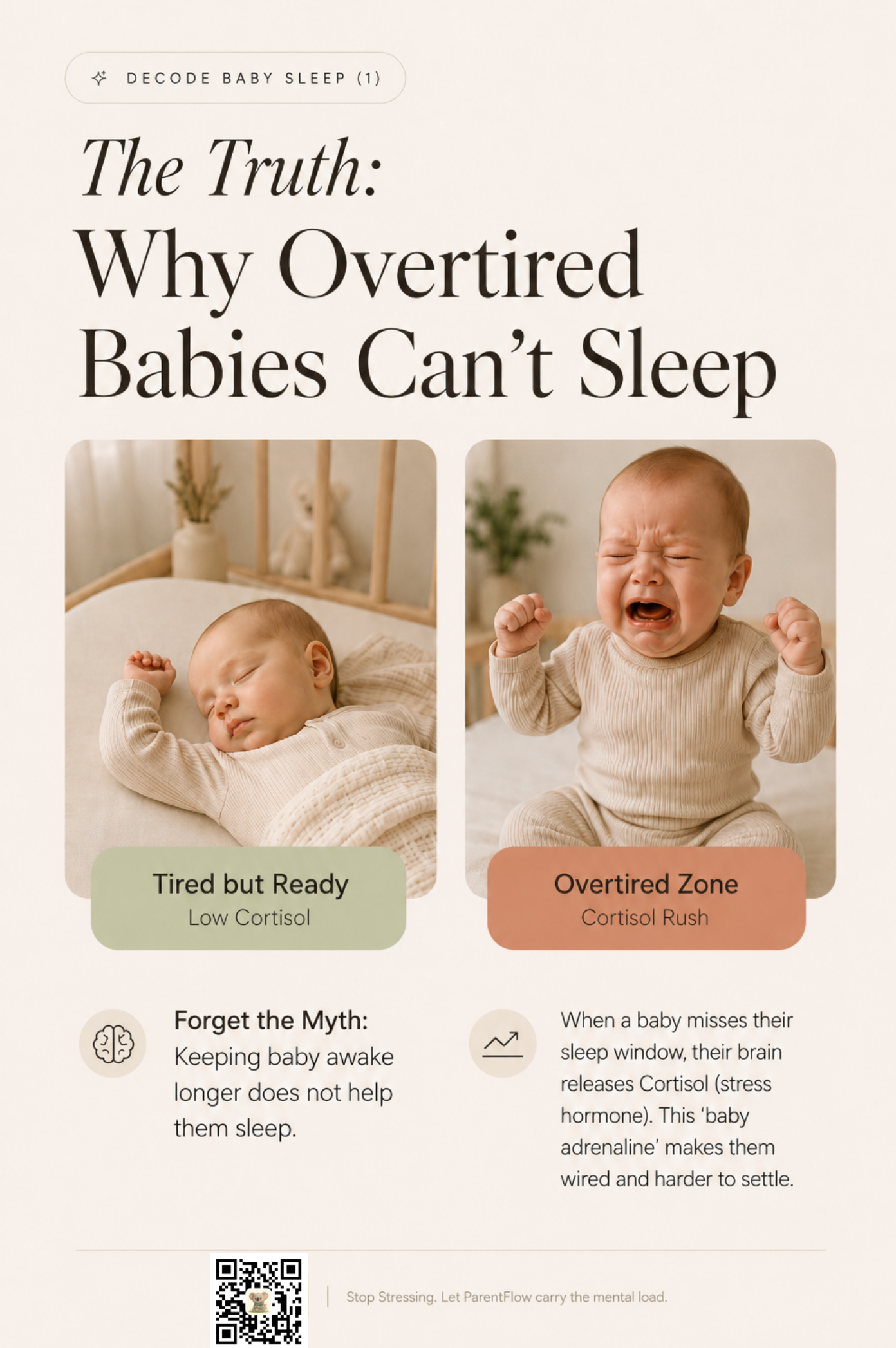
The cortisol trap
The body has two systems that influence sleep. The first is sleep pressure — a gradual chemical build-up of adenosine that makes us drowsy. The second is the HPA axis, which secretes cortisol when the body is stressed or has been awake too long.
In adults, this collision shows up as a “second wind” — you stayed up too late, suddenly you feel weirdly alert. In babies it’s the same mechanism, but the system is younger and more reactive. Cortisol can flip a drowsy newborn into a wired, screaming one in minutes. And once it’s circulating, it has to come down before sleep can resume.
What “overtired” actually means
Pediatric sleep clinicians distinguish three states:
- Sleep-ready. Soft eyes, slow blinks, slight pause. The body is asking for sleep and the brain is ready to let go.
- Past-tired. Eye-rubbing, ear-pulling, increased motor activity. The window is closing. You have minutes, not the next hour.
- Overtired. Crying, arching, frantic limbs, red face. The cortisol has fired. Sleep is now biologically harder, not easier.
The paradox most parents hit is treating the third state like the first — trying a calm, gentle bedtime routine after the baby is already wired. It doesn’t work because the chemistry has changed.
Early cues vs. late cues
Catching sleep cues early is one of the highest-leverage skills of the first year. The early signs are quiet and easy to miss:
- Earliest: a softening of the gaze, a brief lull in play, a tiny yawn.
- Active: rubbing eyes, pulling ears, sucking on hands or fingers, becoming clumsy or quiet.
- Late (already past): crying, arching, refusing to be put down, “wired” energy that resists every soothing technique.
A useful rule of thumb: if you can see the cue across the room, you’re already late. The good cues are subtle.
Recovery: what to do when you missed it
If your baby is already overtired, the textbook nap routine won’t land. Instead:
- Dim the room immediately. Visual input keeps cortisol elevated.
- White noise loud, then taper. Match the room’s sound floor to the baby’s arousal, then ramp down as they settle.
- Re-create the womb. Swaddle (if under 4 months and not rolling), shush, sway. Contain the body.
- Accept the contact nap. A 10-minute nap on your chest is more restorative than 30 minutes of failed crib settling. The goal is to break the cortisol cycle; the goal is not perfection.
One last thing
Reading sleep cues is not magic and it’s not something you have to be born with. It’s pattern recognition that gets faster with reps. Track the times your baby falls asleep easily for a week, and the average wake window will quietly reveal itself.
Sources & further reading
- Mindell, J. A., & Owens, J. A. A Clinical Guide to Pediatric Sleep: Diagnosis and Management of Sleep Problems. Lippincott Williams & Wilkins.
- American Academy of Pediatrics. Healthy Sleep Habits for Babies. HealthyChildren.org.
- Spruyt, K., Aitken, R. J., So, K., et al. (2008). Relationship between sleep/wake patterns, temperament and overall development in term infants. Early Human Development, 84(5).
- Tham, E. K., Schneider, N., & Broekman, B. F. (2017). Infant sleep and its relation with cognition and growth: a narrative review. Nature and Science of Sleep, 9, 135–149.
Track every feed, nap, and night-wake — in one calm log.
ParentFlow helps you spot the rhythm of your baby’s sleep without spreadsheets or guesswork.
Download on App StoreThis article was written against current AAP, CDC, WHO, and IBCLC clinical guidance and is for educational purposes only. It does not constitute medical advice. ParentFlow is a wellness companion — not a substitute for your pediatrician. For medical concerns, always consult a qualified healthcare provider.
All third-party trademarks, organization names, and publication titles are the property of their respective owners and are referenced under fair use for educational purposes.