Why silence is the enemy of newborn sleep.
For nine months your baby grew inside an 80-decibel environment — roughly the volume of a running vacuum cleaner. A perfectly silent nursery isn't soothing to a newborn nervous system. It's startling.
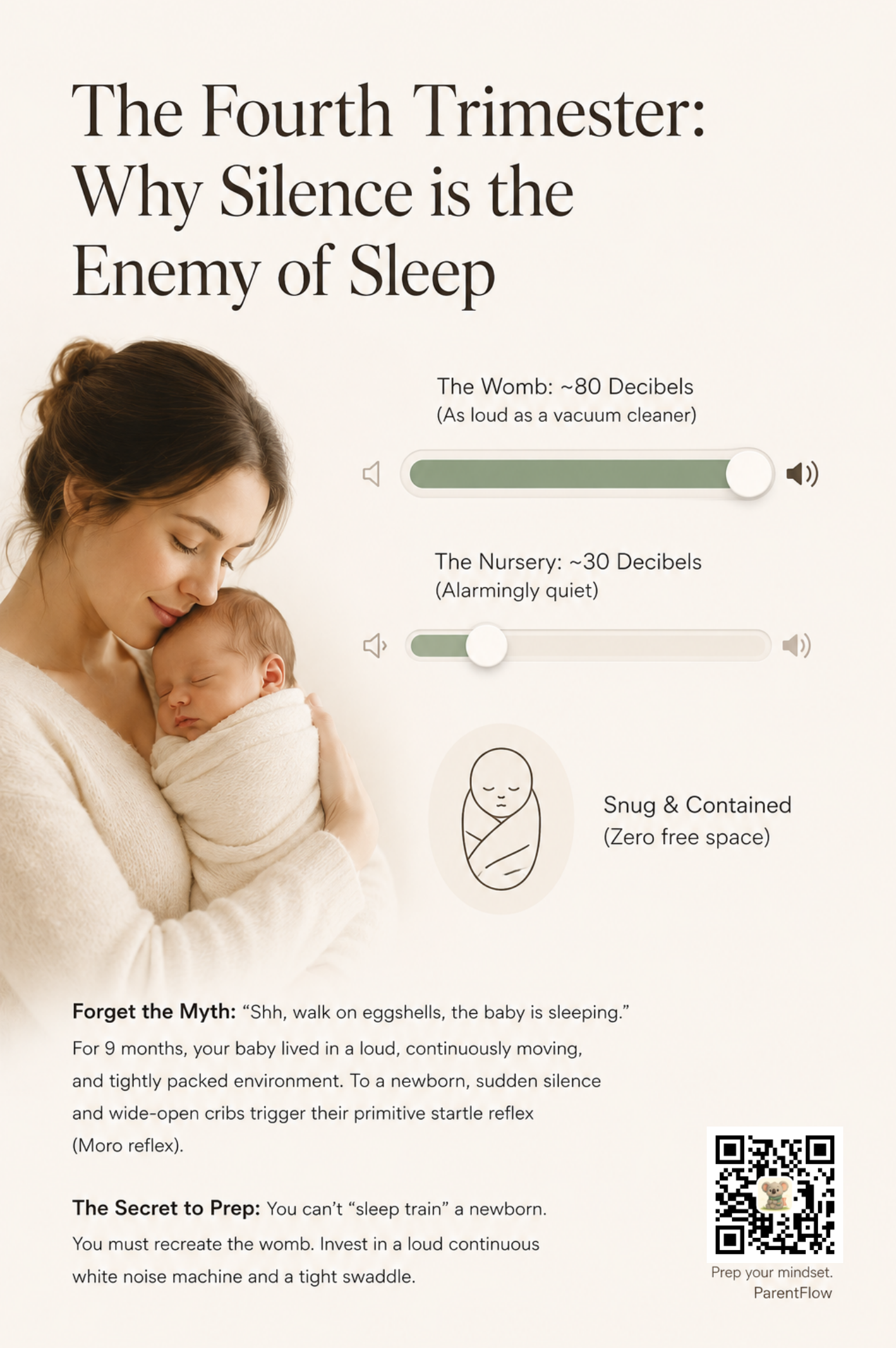
The womb was never quiet
Researchers studying fetal acoustics estimate the in-utero sound floor at roughly 70–85 decibels — about the volume of a running vacuum cleaner or a busy restaurant. The blood flow through the umbilical artery, your heartbeat, your voice transmitted through bone and tissue, and the muffled rush of digestion form a constant, low-frequency soundtrack your baby has been hearing for months.
By the time your baby is born, their nervous system has been calibrated to that hum. A silent room isn't peaceful to them. It's an environment that has never existed before.
What "the fourth trimester" actually means
Pediatrician Dr. Harvey Karp popularized the term fourth trimester to describe the first three months of life as a continuation of pregnancy. Human newborns are uniquely under-developed at birth — a trade-off our species made so that large heads could pass through narrow pelvises. The result: a newborn is still neurologically "in utero" for several more months.
This is why the things that calm a fussy newborn map almost exactly onto the conditions inside the womb: snug containment, gentle motion, continuous sound, sucking, and being held close. Karp calls these the "5 S's" — swaddle, side or stomach position (for soothing, never sleep), shush, swing, and suck.
The Moro reflex — and why open cribs disrupt sleep
All healthy newborns are born with the Moro reflex, sometimes called the "startle reflex." Sudden noises, light changes, or the sensation of falling trigger it: the baby's arms fly out, fingers splay, and the whole body jolts. In a wide-open crib, even a small environmental change — a creaking door, a sibling's footstep — can fire the reflex, which then wakes the baby completely.
In the womb, the reflex existed but had nowhere to go: the baby was tightly contained. After birth, the reflex fires often and disruptively until it begins to integrate around 4–6 months. Until then, recreating containment and steady sound prevents most reflex-triggered wake-ups.
What to do instead of silence
- Use continuous white noise at the head of the crib, not at maximum volume. The American Academy of Pediatrics recommends keeping infant sound machines at moderate volume. A 2014 study in Pediatrics found commercial machines can exceed 85 dB on their highest settings — louder than safe occupational limits. Place the speaker at least 7 feet from the baby and keep volume at or below 50 decibels — roughly the level of a quiet office or light rain.
- Swaddle snugly for the first 2–4 months. Properly fitted swaddling reduces Moro-triggered wake-ups and helps newborns reach the deeper stages of sleep. Stop swaddling the moment your baby shows any sign of rolling.
- Don't tiptoe. Normal household sound during daytime naps — conversation, dishes, music — helps your baby become a more flexible sleeper. Babies trained on silence often wake at every small disturbance.
- Match the room to the womb, not to your idea of a nursery. Slightly cool, dim, gently noisy, snug. That's the environment a newborn nervous system is calibrated to.
One last thing
The instinct to create a hushed, sacred space for your baby is loving. It's also, for the first three months, working against your baby's biology. Recreating the womb feels counterintuitive — it shouldn't. Trust the sound, the snug, the closeness. Silence comes later, when their nervous system can finally relax into it.
Sources & further reading
- Karp, H. The Happiest Baby on the Block. Bantam Books.
- American Academy of Pediatrics. Healthy Sleep Habits for Babies. HealthyChildren.org.
- Hugh, S. C., Wolter, N. E., Propst, E. J., Gordon, K. A., Cushing, S. L., & Papsin, B. C. (2014). Infant Sleep Machines and Hazardous Sound Pressure Levels. Pediatrics, 133(4).
- American Academy of Pediatrics Task Force on Sudden Infant Death Syndrome. Sleep-Related Infant Deaths: Updated 2022 Recommendations. Pediatrics.
Track every feed, nap, and night-wake — in one calm log.
ParentFlow helps you spot the rhythm of your newborn's first months without spreadsheets or guesswork.
Download on App StoreThis article was written against current AAP, CDC, WHO, and IBCLC clinical guidance and is for educational purposes only. It does not constitute medical advice. ParentFlow is a wellness companion — not a substitute for your pediatrician. For medical concerns, always consult a qualified healthcare provider.
All third-party trademarks, organization names, and publication titles are the property of their respective owners and are referenced under fair use for educational purposes.